Scientists from the Ministry for Primary Industries (MPI) are part of an international team working to develop a low-cost diagnostic tool that could significantly improve food crop production in developing countries.
The rapid test uses a combination of chemistries to identify plant disease and will allow growers to remove unhealthy plants in the field early in their growing season, enabling them to increase crop production of important food sources such as maize.
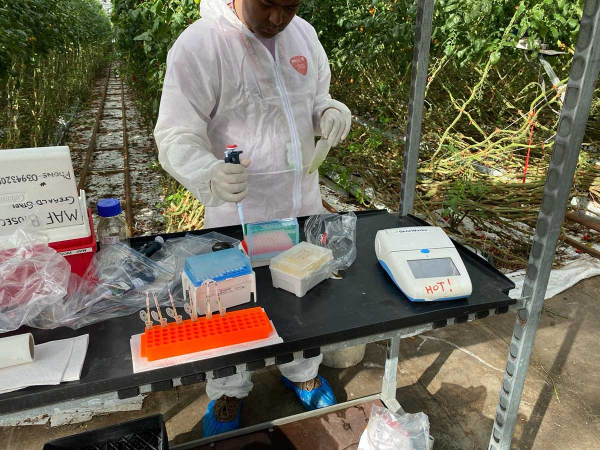
MPI’s Plant Health and Environment Laboratory (PHEL) scientists are working with researchers at Northwestern University (NU) in Illinois, to build the PlantdX2.0 tool, which has shown positive results in field trials in New Zealand and Kenya.
The ultimate aim of the project is to produce a test line read out system, like Covid RAT tests, that farmers can use in the field to test their crops for specific diseases.
Jeremy Thompson, PHEL team manager virology and phytoplasmology, says that early prototypes of the test were trialled in New Zealand for detecting virus infection in symptomless tomato plants.
“More recently the tests have been trialled on food crops in Kenya’s Maseno area where beans, sweet potato and maize are some of the main staple crops,” Thompson says.
“Much higher yields can be achieved if growers can identify and remove diseased plants from the field early,” he adds.
The project is funded by a $1 million USD grant from the Bill and Melinda Gates Foundation, which supports projects to advance developing countries, and led by Julius Lucks, Professor of Chemical and Biological Engineering at NU.
Mid-way through the two-year trial, the goal is to produce a tool that is cheap to make and easy for farmers to use.
Thompson says the test could also be used by farmers in New Zealand and other developed countries to improve crop production.
“The project is looking to make the technology available to New Zealand farmers and growers to test for specific viruses or diseases in crops.
“While the focus of this research is to develop a reliable diagnostic tool for plants, the test could also in future be applied to animal and human health.”