
'Clip board' council out of touch
Commercial grower Bruce Rollison says he's spending a lot of time dealing with existing regulations and planning to deal with new ones that keep appearing.
 increase font size
 Chaos again prevails over the future of resource consents in the Horizons Regional Council region.
Chaos again prevails over the future of resource consents in the Horizons Regional Council region because of an Environment Court judgement on the implementation of its controversial One Plan.
The Environmental Defence Society (EDS) and Fish and Game (FAG) challenged Horizons’ implementation in the Environment Court and the court agreed, saying it was unlawful.
At this stage, 46 consent applications now being processed by the council have effectively been rejected because Horizons doesn’t have a plan to deal with them because of what the court has now ruled.
The council can now only say that the court’s decision does not apply retrospectively, meaning any previous consents are okay. But even this view is being questioned by EDS spokesman Gary Taylor, who says if the process of granting those consents wasn’t lawful it casts doubt on them. He says the council may need to look at this and other issues.
The court’s decision has taken Horizons by surprise; others aware of the issues are aghast at the decision and wonder whether a workable implementation process can be found that is legal and meets the needs of farmers, commercial growers and EDS and FAG.
Rural News understands Horizons now doesn’t know what to do. The council is asking people who have applied for consents to withdraw and be refunded their application fee.
The council is also telling farmers that any future consent lodged must be robust enough to meet the new standards, but it can’t say what these will be. In essence the consents process is paralysed and there is no obvious solution in sight.
There also appears to be problems with the use of Overseer, which could affect consents for commercial growers in Horowhenua.
In addition, the Environment Court seems to be saying it is not interested in practicality or reasonableness and has held that consents should be made on numbers alone.
Horizons may reasonably conclude that the court seems to have little interest in whether a farmer will go bankrupt if a consent application is declined. The court says in its judgement that the economic circumstances of an individual should not be a consideration.
“That is not a reason to manipulate or pervert plan implementation” the court says.
Commercial grower Bruce Rollison says he's spending a lot of time dealing with existing regulations and planning to deal with new ones that keep appearing.

Applications have now opened for the Horizons Regional Council Don Linklater Memorial Bursary.
Federated Farmers says it is pleased that Horizons Regional Council (Manawatu-Whanganui) has recognised the need to get work done on-farm by empowering them to fix infrastructure without getting consents.
After more than a decade of at times acrimonious wrangling, it seems that peace is breaking out on how to manage the environment in the Manawatu, Whanganui and Rangitikei districts.
After more than a decade of at times acrimonious wrangling, it seems that peace is breaking out on how to manage the environment in the Manawatu, Whanganui and Rangitikei districts.



Fonterra has revised its Farmgate Milk Price forecast for the 2026/27 season, lifting the midpoint and narrowing the range on the back of improving global dairy commodity prices.
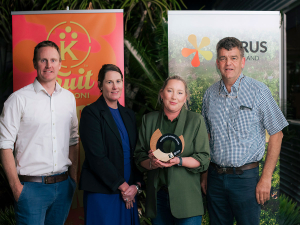
New Zealand's citrus growers were challenged to build their future on the value embedded in their fruit rather than the volume they produce, at Citrus New Zealand's annual gathering in Gisborne on 17 September.
Leading John Deere technicians and apprentices from New Zealand and Australians were recognised at the recent sixth annual JD Technician of the Year Awards, held in Brisbane.
In Dacre, near Invercargill in New Zealand’s South Island, Bruce Dinnington is running a dairy operation unlike any other.
A free online platform aggregating governance vacancies across rural and regional New Zealand has been launched.
Environment Minister Nicola Grigg has announced details of a new rural plastics recycling scheme.