Rural Mobile Coverage Worse After 3G Shutdown, Survey Finds
Mobile phone coverage and reliability are deteriorating in rural areas, and farming families are bearing the cost, according to a Federated Farmers survey.
 increase font size
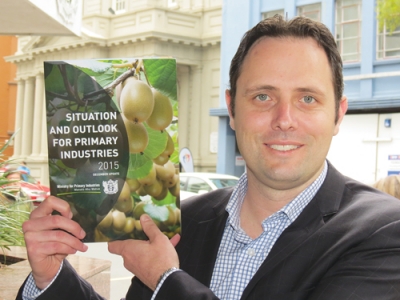 SOPI report author Jarred Mair.
The Ministry for Primary Industries says E-commerce has huge potential for the New Zealand primary sector.
Its director of sector policy, Jarred Mair, told Rural News the opportunities to market our primary products in this way are astronomical. The world is moving towards this and it won't change, he says.
The importance of E-commerce is highlighted in MPI's latest update on the primary sector. It highlights that online retailing has soared in the Asia Pacific region and especially in China, the main market for many of NZ's primary exports.
MPI says China in 2013 surpassed the USA to become the largest E-commerce market in the world; transactions are likely to reach $866 billion this year. Currently NZ sells infant and health formula, health products, honey, liquid milk and lamb online in China.
The report notes that special online shopping events are promoting E-commerce to Chinese singles especially. A lot of work is being done to speed up delivery of online orders: the record is 14 minutes in China.
The report updates its forecasts on the primary sector and predicts primary sector export revenue for the year ended June 2016 will be $37.6 billion – up $1.9b on the 2014-15 season. This rise would have been greater but for the expected decline in dairy exports by 4% to $13.5b. However, MPI expects an increase in 2016-17 to $17.9b.
MPI says milk production for this season will be down by 7%, but that doesn't take into account the effect the El Nino may have. Dairy prices are stabilising but any recovery will be slow because milk stocks are depleted.
MPI notes that demand for premium food products in Asian countries is increasing, driven by economic development and increasing consumer concerns about health.
Demand is high for liquid milk, seen as fat free and high in calcium. MPI says that while Asian countries have doubled their imports of liquid milk, exports of liquid milk from NZ have remained static at low levels.
Meat and wool revenue is expected to rise to $910m this season and then reach $1.05b by 2016-17.
Mobile phone coverage and reliability are deteriorating in rural areas, and farming families are bearing the cost, according to a Federated Farmers survey.

Testing confirms H5 bird flu in a single northern giant petrel, found dead on a remote Cape Palliser beach in the Wairarapa, says Dr Mary van Andel, the Ministry for Primary Industries' (MPI) Chief Veterinary Officer.
The apple sector is working with the Government to unlock access to two key markets that could bring millions in revenue for apple growers.
A Palmerston North shearer has been sentenced to six months' community detention and 12 months' supervision after being found to have physically abused three lambs while shearing them.
OPINION: A simpler, clearer, more effective Recognised Seasonal Employer (RSE) scheme.


Combine premium New Zealand products, blend in a family ritual and what do you get? A world-class functional drink.

Entries are now open across eleven regions for the 2027 New Zealand Dairy Industry Awards (NZDIA).
Safer Farms is urging farmers to make sure everyone working on farm has safe, suitable footwear for the job.
The Government is backing work on a community-led water storage scheme that could irrigate up to 11,000 more hectares of the Poverty Bay flats, Agriculture Minister Todd McClay says.
Agri-tech company Herd-i has become a new all-region sponsor of the New Zealand Dairy Industry Awards (NZDIA), the largest nationwide celebration of excellence in the dairy sector.
Four candidates have been confirmed for two director positions on Fonterra’s board.