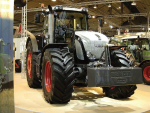
Fendt 900 Vario Marks 50,000 Units With Anniversary Edition
Fendt's 900 Vario was unveiled at Agritechnica 1995 and has since gone on to become a popular choice for farmers and contractors worldwide.




 increase font size
 Dr Tobias Ehrhard
Like many manufacturers around the world, European agricultural machinery and tractor manufacturers are currently operating in a difficult market environment. But they are heading to the world’s largest agricultural machinery event in Hanover next month with a degree of cautious optimism.
Looking back on the past six months, the effects of the downturn that began across the board in 2023 are still visible. While manufacturers producing in Germany still had to record a 28% decline in sales in 2024, this decline melted away to around 10% from January to June 2025, with all product segments affected by the market decline.
Dr Tobias Ehrhard, managing director of the VDMA Agricultural Machinery Association, says that although order intake rose noticeably in most product segments during the first half of 2025, the sales situation remains unsatisfactory.
“An upturn has been expected for some time, but it is not really materialising at the moment,” he says.
Interestingly, technology used in the milk production chain is currently performing particularly well, with milking, cooling, and feeding equipment showing above-average performance in the market. In most other segments, business continues to stagnate.
With machinery fleets aging, manufacturers are expecting demand to rise again in the medium term, but until then, one unpredictable factor of uncertainty remains – the US government’s tariff policy. The import tariffs are a major burden for European agricultural machinery and tractor manufacturers, given the industry is one of the top exporters to the US.
In July, the Trump administration imposed a 15% import tariff on imported goods, further exacerbated by an increased tariff on steel and aluminum products that was introduced on August 18. Since then, the steel and aluminum content of a machine has been subject to a 50% tariff.
In real terms, this means that the previous flat-rate 15% rule has effectively been abolished. Currently, the steel and aluminum content of all machines must be recorded and customs duties paid accordingly. The basis for assessment is the purchase price of raw materials, creating a huge bureaucratic and cost factor, but also, an unprecedented distortion of competition.
In addition, compared to other branches of mechanical engineering, the agricultural machinery industry is particularly hard hit by this protective measure. Typically, the increased tariff rate in mechanical engineering affects an average of 30% of EU export volume, but in agricultural machinery it is 70% on average.
The agricultural machinery industry plays a key role in productivity and growth in global agriculture, with machines, equipment, and associated software systems “Made in Europe” used in more than 130 markets around the world.
In November, the focus at Agritechnica Hanover will be on technologies that combine power, efficiency, and sustainability. Linked to this are digitisation, automation, and automation. Minimising CO2 emissions from the operation of agricultural machinery and tractors is another goal for agricultural machinery manufacturers, who continue to develop climate-friendly alternatives to diesel fuel.
VDMA Agricultural Machinery comprises around 220 manufacturers of innovative agricultural machinery, tractors, and software systems. With 150,000 employees in Europe, around 40,000 of whom are based in Germany alone, the agricultural machinery industry is one of the leading sectors in mechanical and plant engineering.
Fendt's 900 Vario was unveiled at Agritechnica 1995 and has since gone on to become a popular choice for farmers and contractors worldwide.
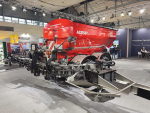
Manufactured in Ireland, tested and launched at Agritechnica in Germany, AgriSpread’s new AS3000 bulk spreader takes much of the technology and features of the well-established AS2000 Series but adds a conveyor system to increase spreading widths up to 30m with lime/gypsum, up to 48m with urea and a whopping 52m with mineral and synthetic fertilisers.
Last month's Agritechnica event led to a wide group of manufacturers celebrating successes when the 2026 Tractor of the Year Competition winners, selected by a panel of European journalists, were announced in Hanover Germany.
Case IH used Agritechnica to reveal its new Puma series tractor, featuring what it claims is an entirely new vehicle design, which allows operators to enjoy a smoother ride with superior manoeuvrability, alongside the latest precision technology.
Creating a great deal of enthusiasm at Agritechnica, the T5.120 ‘Il Trattore’ styling concept tractor was celebrating the legacy of research and development, engineering, and design expertise, with the concept bearing a striking green and red colouring and styling inspired by the original first Fiat tractor, the Fiat 702 and the ‘Made in Italy’ logo.


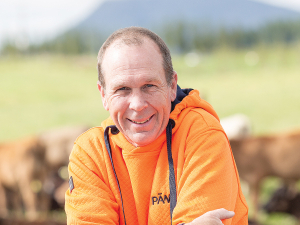
Pāmu has released its FY26 Integrated Annual Report, reporting a Net Operating Profit of $113 million, more than double the $49 million recorded in FY25.

Meat Industry Association data, released alongside the Red Meat Sector conference in Wellington, shows export value climbing across the US, China, UK and Canada.
Applications are set to open for the 2027 Zanda McDonald Award, a trans-Tasman award recognised for identifying and fast-tracking talented young leaders in agriculture and agribusiness.
The Royal New Zealand College of General Practitioners (the College) and Hauora Taiwhenua Rural Health Network are calling for investment in a proposed new training pathway for rural GPs, warning that many rural practices are struggling to recruit while a large share of the existing workforce nears retirement.
Federated Farmers has called on Central Otago District Council (CODC) to drop or vote down a plan to truck sludge from Alexandra and Cromwell to farmland near Lauder, warning it would compound an "outrageous" situation created by a separate council's decision weeks earlier.
Synlait has swung to second-half profit as operations stabilise, but the dairy processor still posted a $75.4m annual loss.




OPINION: The same mainstream media muppets that brought you Jacindamania in 2017 have been flat out pimping for the Opportunities…
OPINION: Your old mate reckons the atrocious way farmers in the UK are treated by their lords and masters in…




