Fonterra CFO Andrew Murray Resigns
Fonterra Co-operative Group chief financial officer Andrew Murray has resigned to take up a role outside the dairy giant.
 increase font size
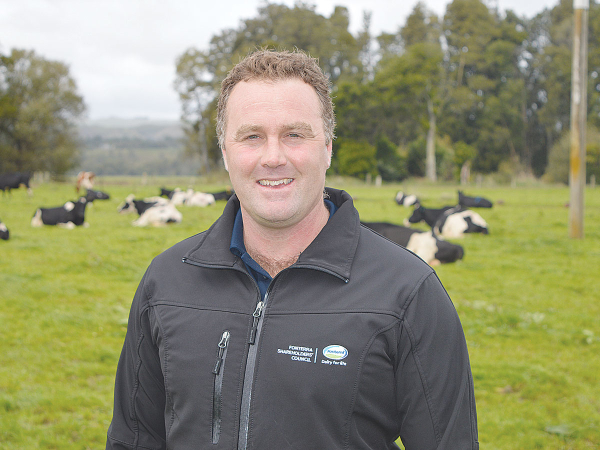 Fonterra Co-operative Council chair John Stevenson says it’s available to pass on farmer concerns and questions to the board.
Fonterra chair Peter McBride says the co-operative isn't thinking about offering farmers any financial incentives for lowering their on-farm emissions profile.
He points out that Fonterra's Scope 3 emissions target, announced this month, is a co-op wide target that will be achieved by building understanding and helping farmers.
"We are not thinking about incentives. The two bottom lines for me are that the measurement on farm need to be more accurate and any incentive needs to be commercially justifiable," he told Rural News.
The co-operative is targeting a 30% intensity reduction in on-farm emissions by 2030, from a 2018 baseline, which will see it further reduce the emissions profile of its products. 86% of Fonterra's emissions come from on-farm, and the new Fonterra-wide target is seeking to reduce emissions intensity by tonne of FPCM (fat and protein corrected milk) collected by the co-op.
The co-op says the Scope 3 target has been triggered by growing sustainability ambitions from customers and financial institutions, along with increasing market access, legal and reporting obligations for dairy.
Fonterra farmers say the target is achievable, but they expect support from their co-op to achieve it.
McBride says the co-op and DairyNZ will help farmers learn from each other through events like discussion groups.
He points out that the emissions profile among different farming systems and within farming systems are quite alarming.
"If you see in the Waikato, farms that produce over 1200 kgMS, their emissions profile per kgMS is 8-18kg carbon equivalent. That's massive.
"So, what can farmers learn from each other?"
McBride says people need to remember that this is a target.
"We've seen progress made without any focus on it. So, when we focus on it and it's in front of your mind, there are things that you can achieve."
Fonterra Co-operative Council chair John Stevenson told Rural News that the target is broadly in line with what customers and other processors have announced.
"Farmers have always been able to adapt to change. I am confident that this target is achievable."
He also points out that Fonterra farmers will also want to understand the value proposition of making these changes.
"Council believes that Fonterra will need to do more work in this area."
Stevenson says he's encouraged that this is an intensity target which encourages farmers to be more efficient and productive.
"This is something we wake up every day to do. Farmers will be looking closely for the arrival of new on farm and novel technologies that will assist them further with their focus on efficiency. Fonterra have invested farmer capital in novel technologies.
"We will be looking for this investment to deliver."
He says the council is available to pass Fonterra farmers questions and concerns through to the board.
Fonterra Co-operative Group chief financial officer Andrew Murray has resigned to take up a role outside the dairy giant.

Four candidates have been confirmed for two director positions on Fonterra’s board.
A record farmgate milk price and strong global demand is laying the foundation for continued growth of organic dairy farming in New Zealand.
Waikato milk processor Tatua has again declared a record milk payout to farmer shareholders, leaving other processors in the dust.
Fonterra has unveiled its annual results for the 2026 financial year, posting $27 billion in revenue and close to $20 billion returned to New Zealand farmer owners and unit holders.


National’s pledge to introduce 19 new national standards shows the party is serious about getting Wellington out of farming, Federated Farmers says.
The National Party’s policies to make it easier to grow fresh vegetables, secure reliable water and energy and simplify farm planning are practical changes that will give growers the confidence to invest, according to Horticulture New Zealand (HortNZ).
Fonterra Co-operative Group chief financial officer Andrew Murray has resigned to take up a role outside the dairy giant.
A major move is about to get underway to improve the quality and viability of dairy beef and cattle in NZ.
Veterinarians say changes to the code of welfare for dairy cattle provides a positive foundation for improved cattle welfare across the country.
Today, 15 October, is the International Day of Rural Women, which recognises rural women’s contribution to farming, communities and the environment.