Farmers are welcoming the announcement of two new bills to replace the under-fire Resource Management Act.
Federated Farmers says the release of the Natural Environment Bill and Planning Bill today is a ‘red letter day’ for the agricultural sector.
"The RMA is the single biggest handbrake on growing agricultural productivity and rural economies. It's great to see its end come one step closer," Federated Farmers resource management spokesperson Mark Hooper says.
"When farmers complain about expensive resource consents, unachievable freshwater targets, Te Mana o te Wai, and outstanding natural landscape overlays, these are all things that sit under the RMA legislation.
"Investment, farmer confidence and productivity have been strangled in red and green tape for far too long."
The Government released two new bills that, once passed into law, will replace the RMA.
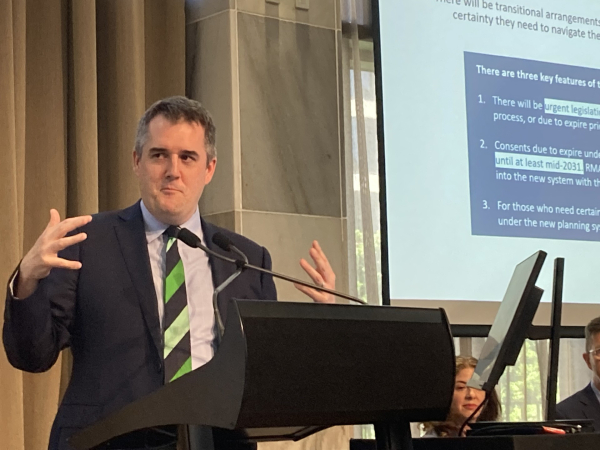
RMA Reform Minister Chris Bishop says the transition arrangements will include additional legislation to extend existing consents which will be passed under urgency in the coming days.
This will give certainty to consent holders, councils and communities while the outdated Resource Management Act 1991 (RMA) is replaced.
“For more than 30 years the RMA has held New Zealand back. It has frustrated farmers and agribusinesses, slowed down housing, delayed infrastructure and added huge cost and complexity for councils, businesses and communities,” Bishop says.
“Our new planning system will cut red tape, unlock growth and improve environmental outcomes. These transitional arrangements make sure people are not forced to navigate unnecessary costs or uncertainty as we move from the old system to the new one.”
Federated Farmers agrees that there are lots of good news in this package of law.
"First of all, under the new law most farmers won’t need a resource consent. Simply by having a certified Farm Plan they will be viewed as compliant with environmental regulations,” says Hooper.
"This makes sense. Farm Plans can achieve much of the same environmental outcomes as a resource consent, without the need to fork out tens of thousands of dollars on expensive planners and lawyers."
The Government has estimated their new laws will nearly halve the current number of consents on the nation’s farms.
"Secondly, where a farmer does need a resource consent, there will be a much, much higher bar for these to be notified, which means they’re opened up for submissions from others.
"When a consent is notified, farmers have to pay for the expensive hearing. This notification cost is what drives consent costs from the tens of thousands of dollars into the hundreds of thousands."
In addition, there should be far fewer instances of when consultation with iwi on individual resource consents is needed.
Cultural impacts will be assessed when environmental limits are set, meaning the need to assess cultural impacts on every resource consent - sometimes from multiple iwi and hapū - should be a thing of the past.
"The days of farmers effectively having large chunks of their farm confiscated in the form of an SNA - Significant Natural Area, ONL - Outstanding Natural Landscape, or SASM - Sites and Areas of Significance to Māori, are also likely to be severely curtailed."
Where a council effectively confiscates a large part of a farm, there is a requirement to compensate the landowner. This will mean this practice is much rarer, and when it does happen, farmers are fairly compensated, Hooper says.