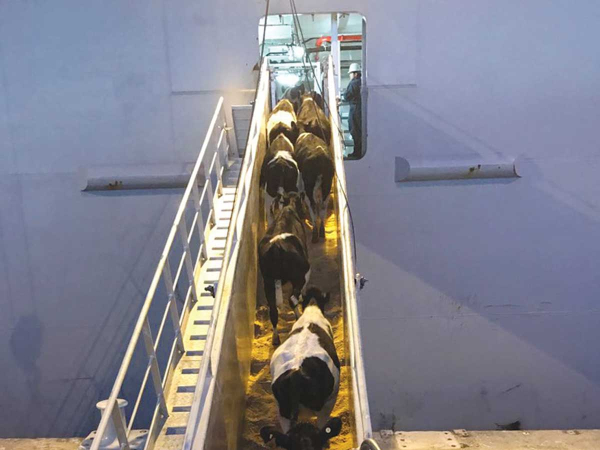
Livestock exporters are hoping to resume shipping animals from August next year.
This follows strong support from all three parties in the new coaltion Government - National, ACT and NZ First - to immediately reverse Labour's ban on live animal exports while ensuring the highest standards of animal welfare.
Livestock Export New Zealand chair Mark Willis told Rural News that they are happy to see this is listed as being a priority item and that the new Government takes animal welfare concerns seriously.
"The industry supports re-starting the trade under high animal welfare regulations," says Willis.
Live cattle exports earn about $320 million annually for farmers and exporters. NZ cattle exports have helped China build their dairy herd, with nearly 135,000 cattle exported in 2021. However, in April this year, Labour banned livestock exports after an independent review said they could damage New Zealand's reputation regarding animal welfare. The reversal of the livestock exports ban is part of the coalition deal between National and NZ First. ACT also supports lifting the ban.
Rural News understands new legislation around reversing the ban could be tabled in Parliament by the middle of next year.
Willis says the first shipment would depend on how long it takes to design and implement new regulations.
“However, we see August 2024 as a realistic target for a resumption.”
Willis points out that according to an Infometrics economic impact study, the ban resulted in a net cost to farmers of around $49,000 to $116,000 a year per farm. Between 1060 to 2900 farms are involved in livestock exports.
“Overall, the ban is likely to impose a net monetised cost to national wellbeing of around $475m per annum, in the short run, and around $320m per annum on an ongoing basis. The costs to financial wellbeing will be concentrated around rural communities.”
Federated Farmers dairy sector chair Richard McIntyre says farmers are delighted that the new Government has made a commitment to reinstate live exports, subject to greater animal welfare requirements.
“Our animal welfare standards are already the best in the world and we are going to make them even better. This is a win for farmers, rural communities and the animals themselves,” he told Rural News.
“It’s been a huge frustration to see footage from other countries with lower animal welfare standards used by campaigners against live export here in New Zealand.”
Willis adds that there is already very little hard evidence of animal welfare issues.
“Livestock export from NZ is conducted in a very safe way and the statistics support the fact that the animals face very few welfare challenges,” he explains. “Often the perceptions created about livestock export don’t come from or apply to the NZ industry. But, yes, like all industries, it can be improved and we are open to being a part of that process.”