Fonterra FY26 Results: $9.69 Milk Price, $3.4bn Profit
Fonterra has unveiled its annual results for the 2026 financial year, posting $27 billion in revenue and close to $20 billion returned to New Zealand farmer owners and unit holders.
 increase font size
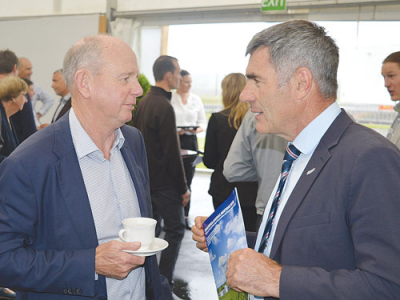 Fonterra Shareholders Fund chairman John Shewan chats with National’s agriculture spokesman Nathan Guy at the co-op’s annual meeting earlier this month.
Large investors are walking away from Fonterra Shareholders Fund (FSF) as the co-op grapples with its financial performance.
Last year 13% of the fund’s institutional investors cashed out, fund chairman John Shewan told its annual meeting in Auckland last week.
With Fonterra having paid only 10c/share dividend to unit holders in 2017-18, investor interest is waning ; units on issue were down 101 million over the previous year and market capitalisation dropped $493 million. As at November 6, 2018, 6.3% of Fonterra shares were on issue.
Shewan told about 60 fund investors at the annual meeting that Fonterra must lift its performance and profitability to regain market confidence.
“If Fonterra turns its performance around and delivers its 25 - 35c dividend per share this financial year, and if institutional investors are confident about the future profitability of Fonterra, we can expect the unit price to improve and drive more institutional demand,” he said.
“At the moment the small size and capitalisation of the fund means there is reduced interest from large investors.
“So if the performance improves and the unit price goes up, market capitalisation will grow and we can expect to see more institutional investors coming back on board.”
Shewan noted there was increased interest from farmers and retail investors; however, some farmers were also buying units and converting them back into co-op shares.
The FSF acquires economic rights of Fonterra shares and issues units to investors; returns are based on the financial performance of the co-op. It was set up under the Trading Among Farmers (TAF) share trading scheme.
Fonterra recorded a net loss of $196m last year, it’s first-ever loss. During the 2017-18 year, the FSF unit price hit a high of $6.66/share on January 11, 2018 and a low of $4.50 on October 10. Last week the unit price was hovering around $4.82/share.
FSF unit holders questioned Fonterra’s farmgate milk price calculation and whether it allowed a higher share of payment to farmers at the expense of unit holders.
Shewan told the meeting the milk price manual was subject to regulatory oversight by the Commerce Commission. “The overall milk price mechanism is robust and fair to unit holders,” he says.
He also played down media comments that TAF presented a conflict between shareholder interests and investor interests.
“It’s not about them and us; we are all in this together,” he said.
Shewan says FSF unit holders are watching the asset review underway in Fonterra in the hope that it will help the co-op lift its profitability.
Fonterra chief executive Miles Hurrell told the meeting the co-op is planning to reduce its debt levels by $800m this financial year.
“Our capital expenditure is set at $650m for the current year -- a reduction of $211m; we are reviewing all discretionary [spending] initiatives in the pipeline and challenging all spending to help us achieve this.”
Hurrell says it is aiming for a return on capital that is “respectable within a global co-op environment [and] I can assure you it does not start with a six.”
Fonterra chairman John Monaghan told the investors that the asset review is well underway; a review of three assets including the Beingmate investment will help reduce debt by $800m.
Shewan stays on
Fonterra shareholders Fund chairman John Shewan was re-elected to the board for another term.
Former Fonterra director Nicola Shadbolt also leaves the FSF and will be replaced by Fonterra director Donna Smit.
The FSF board comprises Shewan, Smit, Fonterra’s independent director Scott St John and unit holder nominees Pip Dunphy and Kim Ellis.
Fonterra has unveiled its annual results for the 2026 financial year, posting $27 billion in revenue and close to $20 billion returned to New Zealand farmer owners and unit holders.

Fonterra Co-operative Group has confirmed the independently assessed candidates standing for election to its board in 2026.
Fonterra has revised its Farmgate Milk Price forecast for the 2026/27 season, lifting the midpoint and narrowing the range on the back of improving global dairy commodity prices.
Outgoing Fonterra Co-operative Council chair John Stevenson says that it has been a privilege to represent the co-op's farmer shareholders.
OPINION: It seems Canterbury processor Synlait is still in the doldrums.


Federated Farmers says it welcomes Labour's commitment to reviewing the Sharemilking Agreements Act, calling on other major parties to do the same.
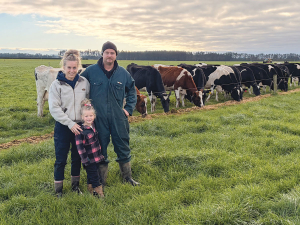
For Canterbury dairy farmers Sian Meijer and Rick Wobben, wearable technology has become one of their most valuable on-farm tools - helping manage 1850 cows across an expansive, high-performing dairy operation while improving efficiency, mating outcomes and day-to-day decision making.
Fonterra has unveiled its annual results for the 2026 financial year, posting $27 billion in revenue and close to $20 billion returned to New Zealand farmer owners and unit holders.
The first major update to the Dairy Cattle Code of Welfare in more than a decade has been released, marking what DairyNZ describes as an important step in ensuring animal welfare standards continue to evolve alongside scientific evidence and on-farm realities.
Ravensdown shareholders have elected Jane Montgomery and Kate Acland to the Ravensdown Board for three-year terms, following a closely contested director election.
Federated Farmers says new legislation replacing the Resource Management Act will cut red tape, unlock investment and help grow New Zealand's export-led economy, after the Planning Bill and Natural Environment Bill passed their third reading in Parliament yesterday.