What Would Synlait Be Worth to Fonterra or a2 Milk?
Speculation of a possible joint move by Fonterra and a2 Milk to buy Synlait raises a much bigger strategic question, says agribusiness expert Dr Nic Lees.
 increase font size
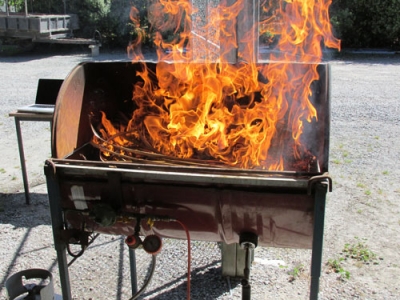 A 'plant barbecue' was used in a joint study to test the vulnerability of New Zealand plants to wildfires.
A 'plant barbecue' was used in a joint study to test the vulnerability of New Zealand plants to wildfires.
The likelihood of destructive wildfires becoming more common as a result of climate change is a major driver behind the joint Lincoln University and University of Auckland study.
Experimental measuring of the flammability of large numbers of plants in New Zealand was carried out for the first time and as the first step in the study. It may lead to new recommendations for shelter belt plantings.
The team was led by Dr Tim Curran of Lincoln's Ecology Department, Dr Sarah Wyse and Professor George Perry of Auckland's School of Environment.
The data they gathered will be used to identify fire-prone ecosystems, as well as species with low flammability that can be planted as green firebreaks to reduce fire spread. The work has just been published in the International Journal of Wildland Fire.
Existing lists of suitable species in New Zealand are mostly based on expert opinion rather than empirical tests.
"Our results provide the first experimental evidence to support current guidelines on New Zealand plant flammability," says Professor Perry. "This provides recommendations for councils and fire managers on which native New Zealand species to plant in green firebreaks to reduce fire spread."
All Black Samuel Whitelock, who was part of the research team, is enthusiastic about the agricultural applications of the results.
"When finishing my Bachelor of Science at Lincoln University I was keen to do research on a topic relevant to my rural roots. This flammability research should help farmers decide which plant species to put in their shelterbelts if they are worried about the spread of fire."
The team placed shoots on a specially designed 'plant barbeque' - a 44 gallon drum cut in half with a grill on top. They lit samples with a blowtorch and recorded how quickly they ignited, how hot they got, how long they burned for, and how much of the sample burned.
Their results generally confirmed current expert opinion, with the most flammable species being gorse, a widespread weed. There were some surprises, however. New Zealand native trees rimu and silver beech were just as flammable as a eucalypt and some other highly flammable overseas species.
Dr Curran says that while the shoot-level flammability measurements represent an important advance in plant flammability knowledge, they are a first step in a wider range of experiments that need to be done on this topic, including refining the testing method and conducting experiments on larger plant samples, and ultimately on plant communities in the field.
He emphasises that planting green firebreaks is just one of the tools that can be used to reduce fire risk.
"It is not a silver bullet to reduce the impact of wildfires, though it can help. Given favourable fire conditions any plant will burn, so green firebreaks are unlikely to work during extreme fire weather."
Dr Sarah Wyse, the lead author of the study and now based at the Royal Botanic Gardens, Kew, UK, is excited for the next steps. "We are now studying how species burn when mixed together in different combinations (a 'mixed grill'). What happens when you burn a highly flammable species like gorse with a low flammability species such as Coprosma robusta (karamu)? Does the mixture burn as well as gorse on its own? Or as poorly as karamu? Answering these questions will help us to predict how invasive plants might influence the flammability of the ecosystems they invade."
Speculation of a possible joint move by Fonterra and a2 Milk to buy Synlait raises a much bigger strategic question, says agribusiness expert Dr Nic Lees.

Lynnette Hudson's 30-year obsession with Pinot Noir was sparked working vintage in Burgundy, seeing how subtle changes in terroir were expressed in the glass. It was, she says, "an elightening moment in every way".
A four year trial has reaffirmed that mixing plantain into dairy pastures can help reduce nitrogen losses to freshwater while maintaining milk production and profitability, say researchers.
Twenty five secondary school students from around New Zealand recently completed a three day residential programme designed to explore career opportunities across the food and fibre production supply chain.
A Lincoln University student is set to become the first person to contest both the Young Viticulturist and the Young Winemaker national titles in one year.


Federated Farmers has welcomed new rural policies released by ACT, saying they align closely with its own election priorities.

Rural Contractors NZ says proposed changes to land transport rules for agricultural vehicles are a welcome response by the Government to out of date regulations which have seen members hit with huge fines.
Alliance is calling for final applications for its 2027 Graduate Programme, with applications closing on Sunday 25 October.
Decades piloting planes has ensured vet and farmer David Hayes is focused on safety. So, after a serious accident while welding on farm, he is sharing his experience so others can learn from it.
Canterbury milk processor, Synlait Milk has confirmed Leon Fung as its chief executive officer.
OPINION: Making it easier to collect rainwater and use it to grow crops and livestock is a no brainer.