A Year of Delivery for Fonterra
Fonterra’s 2026 financial year was a year of delivery, with record volumes of milk collected, processed and shipped by the co-op.
 increase font size

Fonterra’s shaky investment in Chinese food company Beingmate is heading for more trouble.
Last night Beingmate, 18.8% owned by Fonterra, announced another forecast earnings downgrade for its financial year ended 31 December 2017.
Fonterra says Beingmate now forecasts a loss of $171 million to $214 million.
And in another major development, four Beingmate directors, including the two directors designated by Fonterra, have expressed reservations relating to some aspects of Beingmate’s financial management and reporting practices.
In a statement Fonterra says it is extremely disappointed by the earnings downgrade and the on-going performance of the company.
“We are seeking more information on the forecast downgrade in addition to receiving Beingmate’s full year financial statements. We will consider the financial implications on our investment for the purposes of our upcoming interim financial results,” the co-op says.
“We are also aware that as part of this announcement, four Beingmate directors, including the two directors designated by Fonterra, have expressed reservations relating to some aspects of Beingmate’s financial management and reporting practices.”
Fonterra says it has ‘total confidence” of its designated directors and that their actions are in the best interests of Beingmate and all of its shareholders.
“We are concerned about the reservations they have expressed and are seeking clarification on the matters of concern.”
Fonterra is represented on the Beingmate board by its China operations president Christina Zhu and a former head of Chinese and Middle East operations Johan Priem.
The latest chapter in Beingmate’s financial performance will cause more concern for Fonterra shareholders.
Fonterra bought Beingmate shares in March 2015, valued at RMB18.3/share; on July 31 this year the shares were valued at RMB 11.97/share.
For the 2017 financial year, Fonterra’s investment in Beingmate took a $37m impairment charge, reducing its value to $617m.
At its last annual meeting Fonterra shareholders expressed concern at the Beingmate investment.
Fonterra Shareholders Council chairman Duncan Coull told the annual meeting that Fonterra farmers were closely watching the Beingmate investment.
But Fonterra says that despite Beingmate’s recent performance, the strategic rationale for its broader partnership with Beingmate still stands.
“We are disappointed that Beingmate is not maximising the opportunity created by the early registration of its 51 formulations under the new registration rules. The Chinese market is growing rapidly and within five years, forecast demand for infant and baby dairy products will be more than the total for other global markets, so the potential remains.
“China is one of Fonterra’s largest global markets, accounting for $3.4 billion of our sales revenue and a normalised earnings contribution of greater than $200 million in FY17. Our business in China has been enabled by our integrated strategy, comprising of Ingredients, Consumer and Foodservice, our China farms and our Beingmate partnership,” Fonterra says.
Fonterra’s 2026 financial year was a year of delivery, with record volumes of milk collected, processed and shipped by the co-op.
Dairy farmers, still holding onto their Fonterra shares despite switching milk supply elsewhere or exiting the industry, now face a stricter share sell-down requirement.
Milk powder prices are continuing their merry run, firming up a potential $10/kgMS farmgate price this season.
Good news for Fonterra farmers. The co-op has raised this season’s farmgate milk price mid-point by 25c to $9.75/kgMS.
OPINION: Political parties are getting plenty of advice and recommendations from sector groups as the election approaches.



Three men have been sentenced in District Courts after Ministry for Primary Industries prosecutions over animal welfare, food safety and cattle tracing offences.
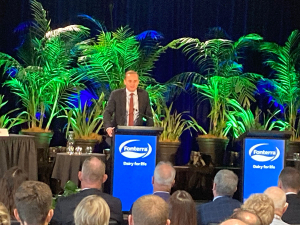
Fonterra’s 2026 financial year was a year of delivery, with record volumes of milk collected, processed and shipped by the co-op.
OPINION: The Government's decision to reinstate agriculture and horticultural science as a standalone subject from Year 11 is the right one.
Dairy farmers, still holding onto their Fonterra shares despite switching milk supply elsewhere or exiting the industry, now face a stricter share sell-down requirement.
Hamilton-based agritech company Aimer Farming has completed a $3 million capital raise to support its next stage of growth, including a beef farming product due to launch in 2027.
When dairy manager Miriam Lauridsen learned the farm, she was joining held weekly health and safety meetings, she initially thought that was “a bit over the top”. Experiencing that culture changed her mind.