
Almond Hulls Trialled to Cut Dairy Cow Emissions in NZ
Almond hulls sourced from Australian orchards may have the potential to help New Zealand cows reduce emissions, boost milk yield and lower input costs.
 increase font size
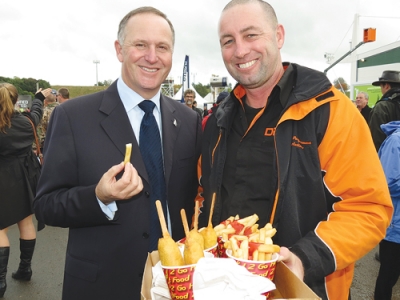 Prime Minister John Key pinches a chip from the lunch of Mark Hohneck at Fieldays.
Prime Minister John Key says the lower dairy payout brings an even greater need for innovation in the primary sector.
Opening the 47th National Fieldays at Mystery Creek, Key noted that the theme of the event – innovation – was appropriate and critical for New Zealand to keep its place as a leading producer of primary products and for the economic survival of many people.
The PM says NZ is now using science to do many things better, such as producing more and better lambs from fewer ewes and improving their survival rates.
“All sorts of businesses here at Fieldays are geared to basically improve the productivity and profitability of what is happening on farm. If you walk around the 1000 displays here, a lot of them have an innovation or science bent. NZ productivity on farm has been dramatically rising and businesses are becoming a lot more productive. It’s one of the reasons why they are able to cope with a higher exchange rate.”
Key says everyone knows dairy is going through a tough time, but last year dairy farmers were looking at an $8.40/kgMS payout.
“It feels a bit tough now when our poor old dairy farmers are looking at a payout that’s got 4 in front of it. That shows why it is so important we keep innovating on farm because we can’t stop the cycles of commodity prices and the variation of exchange rates.
“But it’s at the toughest of times that we have to keep investing on farm and using that research and new techniques to make sure we lift profitability in what we are doing. Dairy farmers are probably feeling a bit nervous at the moment, but I am told things are going to recover.”
Key says the news that Fonterra is to shed staff and that its performance is being questioned is healthy – inasmuch as it’s the [farmers’] right to challenge the board and make sure they [the farmers] feel comfortable with its directions and decisions. But Key says it’s not for him to make a judgement as he is not an owner of Fonterra. He sees a lot of good things coming out of Fonterra.
He is also impressed with the efforts of the other primary sector groups, and he singled out kiwifruit as a sector that is picking up.
“It wasn’t that long ago that PSa was wreaking havoc in the kiwifruit industry. Today we are seeing kiwifruit doing immensely well,” Key says.
Almond hulls sourced from Australian orchards may have the potential to help New Zealand cows reduce emissions, boost milk yield and lower input costs.
New Zealand wool is reaching new heights as air filtration companies move away from synthetic products to biodegradable alternatives.
New Zealand dairy farmers are set to be the first in the world to receive access to a new digital physical milk pricing tool that enables them to fix the price for their physical milk.
OPINION: Former politicians seem incapable of staying away from the limelight after they retire.
Makers and retailers of animal health and crop thriving products are backing the Government’s plan to step up approval processes for new offerings.


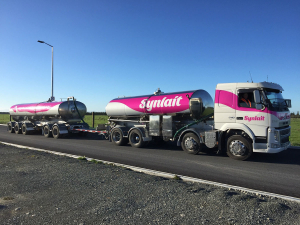
Synlait has swung to second-half profit as operations stabilise, but the dairy processor still posted a $75.4m annual loss.
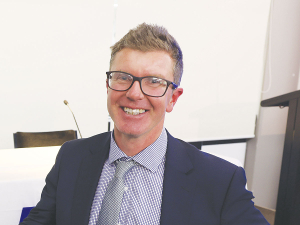
LIC shareholders have elected a new North Island representative to the co-operative's Board, along with five representatives to its Shareholder Reference Group (SRG), following the company's Annual Meeting held in Invercargill.
Farmers across parts of Southland and South Otago are continuing to deal with difficult conditions after a prolonged run of wet weather, with pressure building around feed supply, stock management, pasture damage, farm infrastructure and everyday workloads.
Federated Farmers says it welcomes Labour's commitment to reviewing the Sharemilking Agreements Act, calling on other major parties to do the same.
For Canterbury dairy farmers Sian Meijer and Rick Wobben, wearable technology has become one of their most valuable on-farm tools - helping manage 1850 cows across an expansive, high-performing dairy operation while improving efficiency, mating outcomes and day-to-day decision making.
Fonterra has unveiled its annual results for the 2026 financial year, posting $27 billion in revenue and close to $20 billion returned to New Zealand farmer owners and unit holders.




