No more tears for onion exporters
Onion exports to the lucrative Indonesian market are resuming after officials negotiated an end to costly pre-export methyl bromide fumigation.
 increase font size
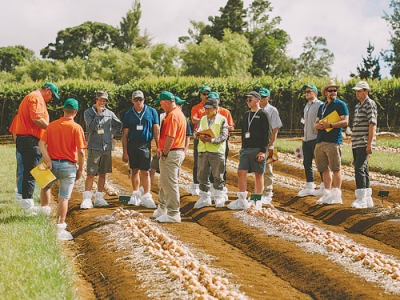 Visitors look over the new onion breeding station at Pukekohe. Photo: Melissa Parker.
A new $2 million Seminis Onion Breeding Station in Pukekohe is “a terrific asset to have in that district in particular,” says Onions NZ chief executive Michael Ahern.
That scale of investment is a “useful amount of money” for the NZ onion industry which is reasonably small on the world stage, Ahern told Rural News.
“We, the NZ industry, are very reliant these days on overseas breeders having material that we can use and that’s not as easy as it sounds,” he says..
“A facility based in this country and having trials in our locality is very welcome. We are very supportive of the whole initiative. The name of the game is trialling and appropriateness for NZ conditions.
“Sometimes these seed lines have been bred for other conditions – the US or Europe – so really you are trying to find the best fit for local conditions out of their full range which is fairly extensive of course.
“Plus there is the intellectual side of it: you’ve got breeders who are then touching on the [growing] community which is fantastic.”
The onion breeding station opened officially late last month is a world-class facility housing state-of-the-art sheds, crop covers and irrigation systems.
It is part of Seminis’ global mid-day onion breeding program, supporting key markets including Australia, NZ, South Africa and Brazil.
Dr Yossi Shapiro, global breeding director for large seed/root & bulb/brassica crops at Monsanto Vegetable Seeds cut the ribbon.
“The Pukekohe station is already yielding significant results for Seminis onion growers in NZ, Australia and further abroad. It adds an important dimension to Seminis’ global onion breeding network, both in knowledge transfer and genetics,” Shapiro says.
“Our investment in the new station demonstrates Seminis’ long-term commitment to Australian and NZ onion growers and to developing onion varieties that meet their needs and suit local conditions.”
At least 40 growers from Australia and NZ attended the innovation day, with key members of the global Seminis onion breeding team who travelled to NZ from the US, Brazil and South America.
The Innovation Day gave growers the opportunity to see new Seminis hybrids and hear from experts on where breeding efforts will be focussed in future.
Local growers were particularly impressed by the wide planting window of the new early maturing variety SVNH1752, which will offer greater flexibility in sowing schedules.
The new variety Currawong was also on show. Currawong is a high yielding, first early variety with resistance to Fusarium basal rot and Pink root.
A very tricky season
Onions are challenged by the weather this year, after a good run for the last three or four years, says Ahern.
And this season’s hurdles were not only growing, but also harvesting.
“This high humidity and several days of rain on end is hard work.
“We will see where we stand in about a month’s time; crops should all be in by then and we will take another look. But at the moment I don’t think anyone is hiding the fact that it is quite a tricky season.”
Onion exports to the lucrative Indonesian market are resuming after officials negotiated an end to costly pre-export methyl bromide fumigation.
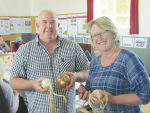
Teachers from around the Auckland, Waikato, Hauraki Plains and Coromandel areas recently got a chance to really know their onions on a mid-March Teachers' Day Out.
A tough onion growing season in New Zealand is causing ripples both here and abroad.
Onion export returns may look good for NZ, but the actual earnings for growers is far from great.
The onion is set to undergo an extreme makeover, with the Government investing $2.83 million in a programme to enhance the competitive advantage of New Zealand’s onion industry, Agriculture Minister Damien O’Connor has announced.
Mainland Poultry has confirmed new ownership of its vertically integrated agribusiness with Pacific Equity Partners Gateway (PEP Gateway) now joining current shareholders Navis.
The recently published State of the Industry -Tractors and Machinery 2025 from the Australian Tractor and Machinery Association (TMA), the equivalent of New Zealand’s TAMA, gives an interesting perspective of the industry.
Strong competition and tightening supply have seen wool reach its highest prices paid at auction since 2011.
The Government is funding a feasibility study to investigate what would be required for a successful farmer-led purchase of the McCain Foods' vegetable processing site in Hastings.
A young man just five years out of his Lincoln University degree already has his foot in the door of farm ownership, as equity manager of a large new dairy conversion now taking shape in Mid- Canterbury.
Visitors to the LIC stand at this year’s Fieldays can expect practical farm conversations, specialist drop-in sessions and exclusive shareholder events.