
No more tears for onion exporters
Onion exports to the lucrative Indonesian market are resuming after officials negotiated an end to costly pre-export methyl bromide fumigation.



 increase font size
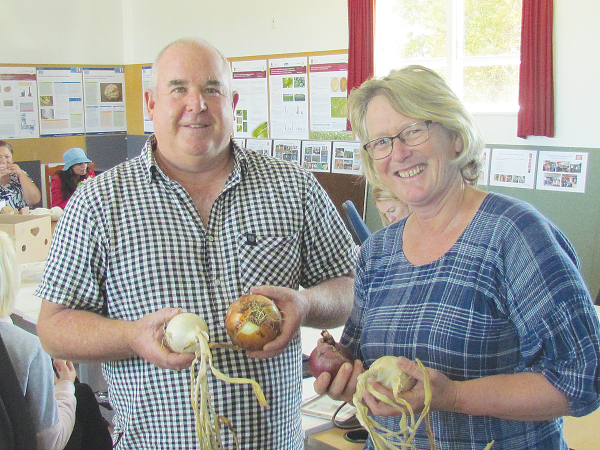 Grant Ryan, director of Allium Solutions, with Hauraki Plains’ College’s Bronwyn Dyer.
Teachers from around the Auckland, Waikato, Hauraki Plains and Coromandel areas recently got a chance to really know their onions on a mid-March Teachers' Day Out.
As well as visits to a dairy farm and vegetable grower, A S Wilcox, the 20 participants heard from Allium Solutions' manager Grant Ryan, about the importance of the onion industry to export returns - as well as the wide range of career prospects it could offer.
The trip was the first of five to be held this year after disruptions due to Covid, with other trips organised in the Wairarapa, Cromwell, the West Coast and Blenheim.
Ryan gave the teachers an insight into the world of onion breeding, which he says isn't a precise science with most pollination carried out by flies. As it takes from 12 to 14 years to move from research to commercialisation of new onion varieties, "you have to know what the markets are doing".
While Indonesia favoured the smallest sized onions, those slightly larger at 50-60mm, were most popular in European markets. Japan preferred the largest 80-90mm onions and with the United States had led the way in breeding sweeter, less pungent onions.
Work was going on developing red onions with more health-giving antioxidants, as well as a candy-striped onion with alternating rings of red and white flesh.
While they're not as sexy as kiwifruit or apples, onions are New Zealand's third largest horticultural export crop and - after tomatoes - the world's most consumed vegetable.
NZ produces around 185,000 tonnes every year on 5,500 hectares, which equates to just two days worth of global consumption. The Chinese, for example, each eat an average of 160kg of onions a year while New Zealanders only manage to consume between 30-40kg.
Inbreeding depression means onions require outcrossing and genetic drift where their shape can vary markedly, can be a problem. With six times more DNA than humans it was challenging to try to breed disease resistance.
"We're working with pathologists and entomologists to develop tolerance," Ryan says. "But we need a lot more younger people coming into the industry to support us. We're not good at engagement with students because we're too busy doing other things."
Ryan acknowledged there were mundane tasks, which needed to be carried out such as collecting bags of onions, weighing them and looking at a comparison of yield advantages. But he had travelled the world in his role and appreciated working outside rather than in a laboratory. And horticulture still had room for small scale growers who had the advantage of being able to be more innovative than larger growers with whome they could collaborate.
Kerry Allen, the agricultural and horticultural science curriculum director at St Pauls School in Cambridge, organised the Pukekohe trip. He is also secretary-treasurer of the Horticulture Teachers' Association (HATA) and a member of the Sow the Seed agricultural and horticultural science advisory team set up by the Ministry for Primary Industries (MPI) and Ministry of Education four years ago. HATA, which has 189 school members, has been carrying out the trips for the last 12 years, connecting teachers and careers advisers with individual growers. This can lead to students visiting growers to back up what they are being taught in the classroom and interest them in a future career.
"We can talk until we're blue in the face but by making these visits they understand more about what we mean," she told Hort News. "They get engaged."
Growers also gained a point of contact if they wanted to employ students for work experince, seasonal work or permanent positions.
Bronwyn Dyer, who teaches Primary Industries and Horticulture at Hauraki Plains College at Ngatea, says the trips are "incredibly invaluable". They gave real life and up to date information which could help to correct students' sometimes narrow understanding of the agriculture and horticulture industries and open their eyes to the wide range of sciene and technology roles available.
Onion exports to the lucrative Indonesian market are resuming after officials negotiated an end to costly pre-export methyl bromide fumigation.
A tough onion growing season in New Zealand is causing ripples both here and abroad.
Onion export returns may look good for NZ, but the actual earnings for growers is far from great.
The onion is set to undergo an extreme makeover, with the Government investing $2.83 million in a programme to enhance the competitive advantage of New Zealand’s onion industry, Agriculture Minister Damien O’Connor has announced.
Bragato Research Institute has signed an agreement on behalf of the wine industry to participate in the $27 million Lighter Touch Programme, alongside other industries including kiwifruit, onions and citrus.


New Zealand's citrus growers were challenged to build their future on the value embedded in their fruit rather than the volume they produce, at Citrus New Zealand's annual gathering in Gisborne on 17 September.
Leading John Deere technicians and apprentices from New Zealand and Australians were recognised at the recent sixth annual JD Technician of the Year Awards, held in Brisbane.
In Dacre, near Invercargill in New Zealand’s South Island, Bruce Dinnington is running a dairy operation unlike any other.
A free online platform aggregating governance vacancies across rural and regional New Zealand has been launched.
Environment Minister Nicola Grigg has announced details of a new rural plastics recycling scheme.
Agricultural drone operators say that a government decision to allow lower-risk drone work without certification won’t lower standards but drive innovation and efficiency.



OPINION: The same mainstream media muppets that brought you Jacindamania in 2017 have been flat out pimping for the Opportunities…
OPINION: Your old mate reckons the atrocious way farmers in the UK are treated by their lords and masters in…




