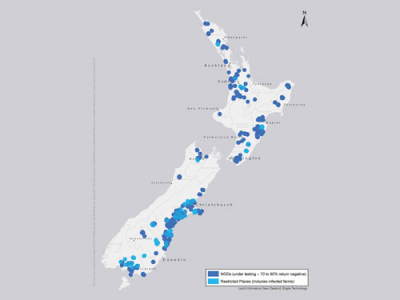
37 farms have been confirmed as infected with Mycoplasma bovis by the Ministry for Primary Industries — eight in the North Island and 29 in the South.
Twenty-one are beef farms, 14 dairy and two are “others.” Including those infected farms, 58 are now listed as ‘restricted places’.
Notices of direction (NOD), which restrict some movement of stock from farms and are usually applied to farms where test results are pending, are in place on 190 properties.
A Biosecurity NZ map of the M. bovis spread indicates that only the Bay of Plenty and Marlborough remain free of the disease, with neither RP notices nor NODs in force.
Taranaki and the South Island West Coast have farms under NODs but as yet no confirmed infection. MPI says 70 - 80% of NODs do not go on to prove infected.
Meanwhile, MPI says eradication continues, with 30 farms now cleaned and depopulated and free to resume operation with new stock.
Simple steps
MPI is calling on farmers to adopt robust biosecurity practices. Simple steps farmers can take include:
- carefully consider the disease status of new stock before animals are bought or moved
- ensure visitors clean and disinfect their equipment, clothing and footwear on arrival at a farm
- make boundary fences secure and prevent nose-to-nose contact with neighbouring stock
- give young calves special protection, allowing only essential people into the calf shed.