
Waikato Dairy Farmer Danielle Hovmand Named Primary Sector's Top Emerging Leader
Waikato dairy farmer Danielle Hovmand has been named the primary sector's top emerging leader.
 increase font size
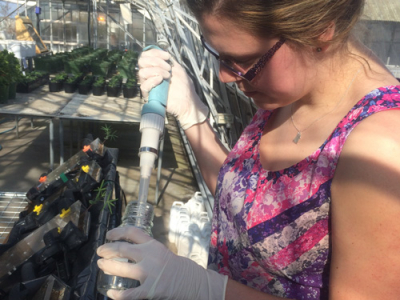 Lincoln University PhD candidate Amy Whitley.
An innate curiosity for 'why things happen' made Lincoln University PhD candidate Amy Whitley a natural fit for scientific research.
Now she's using that curiosity to improve New Zealand's soils and raise the productivity of low fertility land in hill and high country areas.
Thanks to Lincoln University and Ballance Agri-Nutrients, Amy is taking full advantage of an opportunity to pursue a doctoral study in soil science, a field she is passionate about and believes holds vital importance to both the local and global economies.
"Soils acidify over time, through natural weathering and land use," explains Amy. "This affects their utility for agriculture and reduces overall productivity – essentially reducing the amount of food we can grow and produce.
"This is not just a New Zealand problem but also a global one too and it isn't going away by itself, so we need to research the issue and find ways to address it."
Her research is part of a body of study that looks into the known association between acidic soils and aluminium toxicity, which affects the growth of plant species and in particular legumes such as clover and lucerne. Legumes are critical to the economic viability of New Zealand sheep and beef production.
"By identifying the key drivers of aluminium toxicity and the relationship with soil pH and other soil characteristics, we can determine the areas that are most susceptible to aluminium toxicity and the resulting low productivity," says Amy.
"This research will help to inform better land use decisions – such as where best to apply fertiliser and lime to get optimal soil productivity and also which mitigation strategies will be most effective."
Despite growing up in urban environment Amy enjoys going out onto farms and says some of the best parts of her research involve getting out into the field and meeting the farmers her research will help most.
"It's hard to complain when the field sampling requires me to travel to some of the most beautiful parts of New Zealand," says Amy. "The farmers we talk to are generally very well informed and know what we're trying to achieve; it's great to know they are interested and supportive of our work."
Amy's research position at Lincoln University is one of many sponsored by farm nutrient co-operative Ballance Agri-Nutrients, who contributed $350,000 last year to support six doctoral candidate positions.
Ballance's science strategy manager, Warwick Catto, says the two organisations share a key focus in advancing soil research to drive innovation that lifts on-farm productivity.
"The cutting edge research being carried out by Amy and her colleagues should deliver key insights on how best to prioritise fertiliser and lime inputs to areas of low fertility that are most prevalent in hill and high country regions. The economic and productivity impact will be huge from prioritising the right lime and fertiliser spend to the right soils and landscapes," says Warwick.
"We're excited to support doctoral research at Lincoln University as part of our wider research and development programme, and are encouraged that bright minds like Amy are passionate about advancing soil research in ways that will generate tangible improvements for both our farmers and primary industries as a whole."
Waikato dairy farmer Danielle Hovmand has been named the primary sector's top emerging leader.
New Zealand’s wine industry produces around 100,000 tonnes of grape marc waste annually, while the forestry sector generates over five million tonnes of wood residue.
A young man just five years out of his Lincoln University degree already has his foot in the door of farm ownership, as equity manager of a large new dairy conversion now taking shape in Mid- Canterbury.
Analysis of decades of research has revealed the good farming pracrtice plays a critical role in reducing nutrient losses to improve freshwater outcomes.
A Lincoln University research fellow is working to safeguard grapevine species from extinction, using careful science and liquid nitrogen.



With the New Zealand/India Free Trade Agreement (FTA) dominating political debate here, India Prime Minister Narendra Modi will be visiting New Zealand next week.
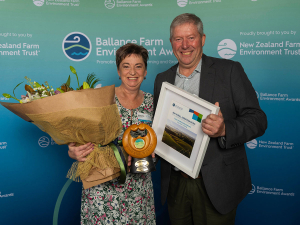
Michelle and Tony Roberts didn't inherit the farming business they have today. They’ve built it from the ground up.
“We’re not normal.” That’s how Jack Walters, executive director of Pungent Pukeko, describes his gin brand, which has just won gold at the World Gin Awards.
Dr Tim Harwood, a seafood food safety research leader, has been awarded the 2026 Significant Contribution Award at the New Zealand Institute of Food Science and Technology (NZIFST) Food Industry Awards.
Today marks the first day of operations for Waikato Waters, a new council-controlled organisation established by six district councils to deliver water and wastewater services for their communities.
The Ministry for Primary Industries (MPI) has announced has opened applications for the 2026/27 funding round of the Greenhouse Gas Inventory Research (GHGIR) fund.