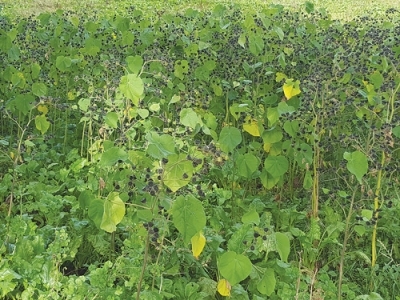
Velvetleaf inspections in Southland will continue until the end of this week.
More than 4,000 hectares of fodder beet crops have been searched.
The Ministry for Primary Industries says it is committed to continue the response partnership with Environment Southland until completion of the inspections on Friday.
Environment Southland chief executive Rob Phillips says the response has been an enormous undertaking, achieved only through the joint effort of many organisations.
"The success of this operation has seen everybody working together to achieve the best outcome for Southland.
"The Ministry for Primary Industries has led the response at a national level and supported Environment Southland to get the work completed. A significant portion of the country's fodder beet crops are planted here in Southland, making the job much bigger and more challenging than elsewhere. It means we've required more support and resourcing, and MPI has been supportive of that."
Staff from Environment Southland and the Ministry for Primary Industries, were joined by staff from other local councils, South Roads, Fulton Hogan, Fonterra, AsureQuality and students from SIT, during the five week response.
Nearly 200 velvetleaf plants have been located, with each plant capable of dropping up to 17,000 seeds, which could devastate future crops and have a significant impact on the livelihoods of Southland farmers.
Once the initial inspections are complete, farmers are urged to continue checking their crops for any signs of velvetleaf, as it is possible any hidden plants make become obvious as they undergo a last spurt of growth before winter.
Further information on velvetleaf can be found at www.mpi.govt.nz