A simple $22 app can save grain growers tens of thousands of dollars each year by optimising the efficiency and productivity of all makes and models of combine harvesters.
HarvestCalc quickly measures grain loss and determines its economic impact based on crop yield, prices, operating speed and operating costs. Operators can use this information to adjust and test the threshing and separation settings on their combine harvester.
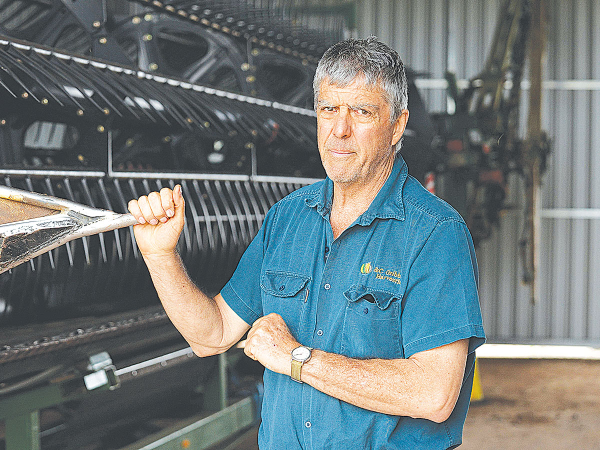
The app was developed by southern NSW harvesting contractor Rod Gribble.
“Every combine harvester loses some grain within the machine itself or across the header,” he explains. “Machine losses at 1% for cereals and 2.5 to 3% in canola/oilseeds are generally regarded as acceptable – yet another 1 or 2 % can also be lost across the header.”
With a balance needed to complete the harvest quickly and minimise losses, Gribble says, as a rule of thumb, grain loss increases with throughput, operating speed and crop yield.
“Conversely, if you go slower, grain loss will decrease but your harvesting costs are going to increase.”
He says the goal is to determine the ‘sweet spot’ between harvesting efficiency and productivity under individual conditions.
HarvestCalc is said to offer the ability to monitor grain loss, calculate its economic impact and then “tweak” the settings of the combine harvester.
The system uses an app that works without a mobile phone service and three grain collection trays. Set-up requires the operator to enter the make and model of the harvester, the header width, separator width and operating cost per hour. In the paddock, the three collection trays are placed across the cutting width – including one under the machine itself, at least 50 metres ahead of the machine.
After making a harvesting pass over the trays, any straw or chaff is removed, before counting and ideally weighing the grains left in the trays. From here, the operator enters the crop type, type of test tray, whether spreading or windrowing, spreading width and average speed.
Then, the number or weight of the grains found in the separator tray and the header loss trays, alongside crop yield is entered and the calculation performed.
HarvestCalc will then automatically calculate grain loss, expressed as a percentage of yield, kg/ ha or $/ha. It will also work out harvesting costs – expressed as $/tonne, tonnes/hour or $/ha. The process should then be repeated at least three times or as necessary to check the effectiveness of any adjustments made to operating speed or machine settings.
The first version of the HarvestCalc app was developed back in 2010. It was redesigned in 2020 and has gone on to be downloaded more than 1300 times.
www.harvestcalc.com