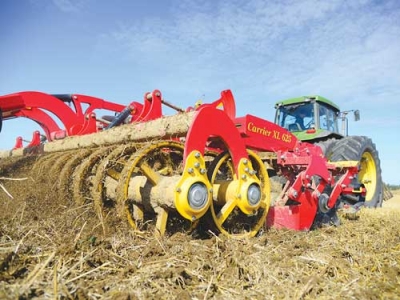
CB Norwood Distributors, importers of Vaderstad cultivators, has launched the maker’s Carrier L and XL cultivators.
This multi-purpose implement is equally at home in stubble – following the header – or in working down ploughed ground during spring.
Layout is over three distinct areas, acting progressively on the job at hand, with a toolbar at the front, followed by the main discs and a packer system at the rear.
The front toolbar is configured to take different setups such as the straw harrow, which spreads residue to make tillage easier and ensure a uniform seedbed for following crops.
The crosscut knife slices everything from green cover to maize stalks while operating at 90o to the discs to ensure all residue is cut in two directions. Lastly, the crossboard option crushes clods or slices and levels ploughed furrows.
The next phase is the disc section set out in an X-form to cancel out lateral forces and ensure a ‘straight’ pull behind the tractor, useful for GPS-guided operations and working on sidling land. Discs are mounted on individual arms, with high clearance for exceptional trash flow through the machine and use the Multi-Set system to allow operating angles 11-19o, set in four increments.
Made from high grade V55 Swedish steel, the discs have a conical design which helps protect the bearing assemblies but, more importantly, helps produce a fine soil and maintains the disc angle irrespective of the working depth or any wear.
Available in a 51cm diameter (L) or 61cm diameter (XL), the discs have a notched edge called TrueCut, which promotes less wear but also maintains constant aggression at work. For customers seeking flexibility, the system uses common disc support arms that allow a change from the smaller diameter discs to the larger and back if required.
Options for the rear-section packer systems are: an open design called CageRunner – easy to pull and self-cleaning; SoilRunner, that has a ‘U’ shaped profile that resists clogging and lowers scraper wear; or SteelRunner, which has a deep profile that presses down stones and crushes clods, suting medium or heavy soils. The latter is also available as a double row version that can be tilted in wet conditions to allow better percolation of water into the soil.
At the rear of the machine a new suspension system on the transport wheels extends their life and, as well as transport, these can be used for manoeuvring in the paddock – particularly in shallow operations – although the operator might choose to make a turn carrying the machines on the packer rollers.
Maximum working depth is controlled on the machine, and on-the-go adjustments can be made hydraulically from the tractor seat.
The Carrier is available in four sizes from 4.25-8.25m working width (425/525/625/825). Interesting to note is how it folds down to a transport width of only 3m and a transport height of 4m – unusual for a disc-based machine that can operate at over 8m in work.
www.vaderstad.co.nz