Family owned harvesting specialist Claas employs about 11,300 people globally and 10% of its workforce is in R&D.
This explains why the lime green machines dominate the grass harvesting market in NZ and overseas.
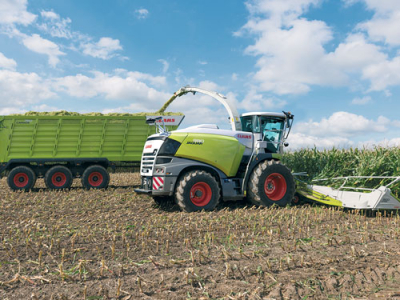
For the 2017 season, Claas Jaguar will be offered in three ranges: Jaguar 800 series (type 496), Jaguar 900 series (type 497) and the new Jaguar 900 series (type 498) – the latter only available for the coming season with Tier 4 Final engines. With 14 models now available across the three families, the Jaguar range is the largest in the market and able to cope with a wide range of operations.
The new Type 498 includes several technological advances: a continuously variable front attachment drive system, enhanced crop-flow and an automated loading system.
Up front, the hydraulically driven attachment drive will automatically adjust its speed as chop length is changed, thereby maintaining crop feed and chop quality.
Particularly useful for grass pick-ups or the Orbis maize header, there is also the ability to use a split system which combines the new hydraulic and the original mechanical drive lines to allow high power transmission at constant speeds. This might be the case with attachments like the DirectDisc cutterbars.
Grass pick-ups can also be equipped with the maker’s Active Contour system to improve ground following accuracy in undulating or hilly conditions, while ensuring clean raking and minimal crop contamination.
The new 900 Series also has an automatically adjusting cylinder concave said to aid crop flow by its working with automated shear-bar setting software. In practice, once the blades have been sharpened and the shear bar has been adjusted to its optimal clearance the concave is also adjusted to its premium setting irrespective of the blade condition.
The AutoFill function, as the name suggests, does exactly that and removes strain from both the harvester and haulage operators by automatically filling trailers, wagons or trucks. A discharge spout mounted, high-resolution camera looks at the transport body dimensions in real time and fills the void automatically.
Also new for the 2017 season are improvements to the main driveline which has been designed to offer maximum tractive power and quick response, especially in difficult terrain or conditions.
A new hydrostatic motor offers two ranges, with field speeds up to 22km/h, while an added function called Cruise Pilot allows precise control of forward speed and reduces engine speed.
A differential lock set-up can be triggered manually or automatically when wheel slip is detected.
www.harvestcentre.co.nz