Operating large tractors became more expensive back in March due to the ongoing Strait of Hormuz conflict, meaning contractors had to introduce fuel surcharges and farmers had to adjust their budget forecasts.
Manufacturers are reporting that potential purchasers are now paying much greater attention to fuel consumption figures, which in many cases also must take account of the addition of secondary Diesel Exhaust Fluid (DEF), most commonly referred to as AdBlue.
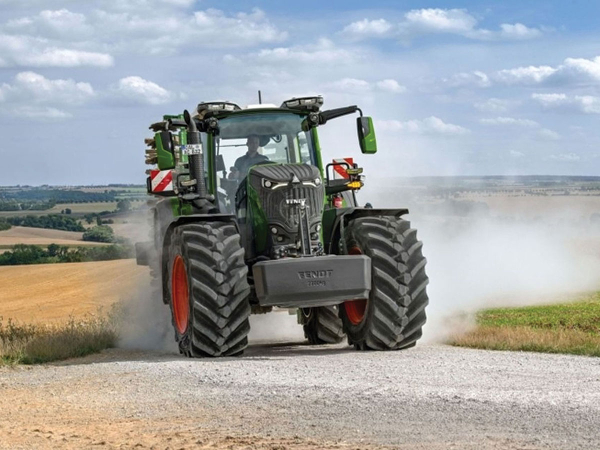
Fendt’s 832 Vario recently evaluated in the DLG PowerMix test averaged a fuel consumption figure of just 235g/kWh of diesel and 29g/kWh of AdBlue in the field, which sets a record for tractors up to 350ps tested in the DLG PowerMix test to date. In addition, the 832 also fared well in for transport efficiency, achieving a best-in-class figure of 331g/kWh of diesel and 36g/kWh of AdBlue at 60km/h, in the large tractor class of over 305ps.
The DLG (German Agricultural Society) introduced the PowerMix test back in 2005 as a response to criticism of existing OECD tractor tests. That criticism stemmed from the fact that OECD tests measured tractors’ features under fixed, laboratory conditions that did not accurately reflect farm work. Indeed, it was suggested that many tractors submitted for testing were “tweaked” to suit the static testing.
This led to the development of the PowerMix test, which uses 14 different test cycles that simulate typical agricultural jobs by combining drawbar work including ploughing and cultivation, PTO work such as mowing or baling, hydraulic demand and transport operations. These standards apply more realistic fuel consumption and efficiency in everyday farming.
The Fendt 832 Vario is powered by a six-cylinder, 7.9L CORE80 engine (which was awarded the ‘Diesel of the Year 2026 Award’), developed by AGCO Power, delivering a maximum power output of 342PS (252kW). On the DLG test bench, it delivered a maximum power output of 232kW and maximum torque of 1553Nm at 1300rpm.
Fendt has credited the tractor’s performance in the DLG PowerMix test to the CORE80 engine, the VarioDrive CVT and the Fendt iD low-speed concept working together, while also noting that its smaller sibling, the Fendt 826 Vario, also achieved noteworthy scores in the DLG PowerMix test, clocking in at 239g/kWh of diesel and 29g/kWh of AdBlue, suggesting that efficiency is not just a feature of the top-of-the-range model, but applies to the entire series.
Visit www.fendt.com/au