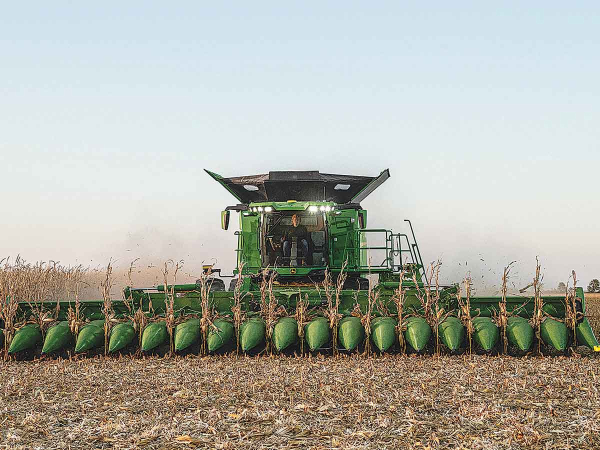
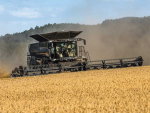
John Deere has announced new automation and efficiency updates on its 2026 model combine harvesters that provide more capabilities and boost productivity by up to 20%.
The updates work to create a smoother harvesting experience and enable less skilled operators to maximise crop quality and maintain harvest progress. Predictive Ground Speed Automation now supports edible beans and lentils, as well as the current crops of peas, wheat, barley, canola, soybean and corn.
In operation, cabmounted cameras sense individual weed patches that are within the crop by detecting characteristics of plant shape and height. Depending on weed density and operator- defined sensitivity, the combine will reduce ground speed as it harvests through these areas to help reduce plugging and help prevent reel or rotor wrapping.
Furthermore, John Deere Operations Centre will automatically send harvest automation files, including crop data from planting, so that satellite views of Predictive Ground Speed Automation are available on all eligible harvesters.
Harvest Settings Automation sets concave clearance, fan speed, rotor speed, sieve clearance and chaff clearance, based on the harvester model, crop type and geolocation. The system now includes an out-ofcrop setting that engages when the harvester is passing through areas already harvested, helping to reduce grain loss and maintain a cleaner tank sample in sparse areas of the field.
On the productivity front, the 2026 models incorporate updates to enhance productivity with less operator intervention, ensuring harvest quality is maintained regardless of operator experience.
AutoTrac Turn Automation provides hands-free turning, by automatically raising and lowering the machine front as it crosses specific field triggers. This reduces the likelihood of missing a crop or starting a new pass in the wrong place, while also benefiting operators harvesting with poor visibility.
A new auto-unload camera mounted to the auger, helps to evenly fill the grain cart, sensing the grain fill level inside the cart and sending in-line nudge commands to the tractor, reducing pressure on operators during unloading.
Users can gain more insights, using features such as Grain Sensing with HarvestLab 3000, that collects and records the percentages of crop moisture, protein, starch and oil content of wheat, barley, canola, corn, soybeans, oats and rye crops. Grain harvest weight sharing shows how much grain is in harvesters and chaser bins, so that the bins are in the right place at the right time.
Up at the header end of the machine, a new three-piece cam reel with dense pack fingers, features 32% more tines compared to previous flip-over reels, providing an efficient sweep from the knife to maximise grain capture, particularly in lodged crops, or when harvesting challenging crops such as pulses.
Cab upgrades include a new instructor ‘stadium’ seat, that when not in use, sees the seat flip up and the back folded down to serve as a shelf. A dual USB-C charging module has been installed in the new models, to charge batteries quickly for mobile devices.
“These updates will unlock the full potential of the John Deere combine harvester, whether it’s anticipating crop variability, fine-tuning weed detection sensing or improving the grain unloading experience,” says Royce Bell, John Deere ANZ, production and precision ag marketing manager.