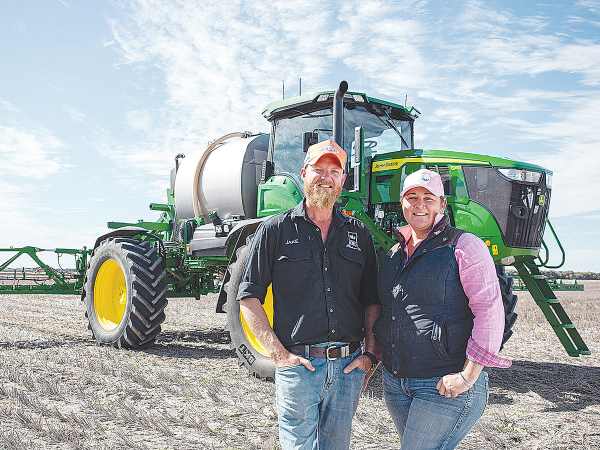
Southern Queensland farmers Jake and Felicity Hamilton say investing in a John Deere 616R self-propelled sprayer equipped with See & Spray Select has been ‘hugely beneficial’ to their dryland cropping business.
They cite the machine’s simplicity, efficiency and ease of use, but most of all, the potential to offer savings in time and money during chemical application, varying from 70% to as high as 95%.
While the Hamilton family has been farming in the region since 1937, the couple notes that the onset of climate change means they need to adapt their cropping regime to more intense rainfall events that are becoming less regular.
“We’ve been chasing efficiency gains and making improvements over the years with John Deere products such as AutoTrac, which has improved pass to pass overlap and section control with older sprayers to save on chemical,” Jake Hamilton says.
“All of these machines and technologies have brought small gains, whereas See & Spray Select has helped us make a huge leap ahead.”
With an annual rainfall of 570mm at their Krui Pastoral property, the Hamilton’s grow mainly winter crops including wheat, barley, chickpeas, faba and mung beans. The summer is too hot to make sorghum viable.
Over a decade ago, the Hamiltons began to invest in more efficient weed technology as part of a move to integrated weed management (IWM).
This came in the wake of the glyphosate resistance of the mid-2000s. The main aim was to stop weed seed-set at all costs, and the program has worked well.
“We used IWM practices, including high seeding rates to create strong crop competition, an incrop and summer residual chemistry program and optical spot-spraying, while also treating sparse, hard-to-control weeds such as Feathertop Rhodes grass with a mobile spraying unit on a John Deere Gator,” Hamilton adds.
“For the last decade, we’ve had a pretty strict regime of using residual herbicides over summer to try to keep our weed burden down, but even with that you’re always going to get escapees. That’s where the See & Spray Select really comes in, because we can just go out and hit any of those escapees without having to spray the whole paddock.”
See & Spray Select integrated camera technology detects green weeds as small as 0.9cm diameter in fallow and triggers a spot treatment application from multiple nozzles to these plants only. The 616R sprayer has increased productivity by not spraying all the time.
The result is less refilling, with a single morning fill allowing the operator to spray all day. With regards to efficiency and ease of use, the sprayer boom folds in 30 seconds and the unit can travel at speeds of up to 55km/h, shortening the travel times between paddocks.
The couple are also quick to add that the See & Spray Select has reduced chemical usage and, in turn, their chemical costs.
“When we’re fallow spraying, we just leave the cameras on all the time, so even if we’re only saving 5 to 10%, that’s still a saving that most businesses would take any day,” Hamilton explains.
Felicity Hamiton adds that the data generated in the cabin also makes it easy to monitor each operation for compliance.
“We have a legal responsibility to document what we’re putting on with the sprayer, at the same time recording weather conditions, the products and application rates, so Greenstar makes this so easy,” she explains.
“See & Spray Select have been hugely beneficial to our business, making us more environmentally and economically sustainable – something we need to keep building on into the future.”