The meat processing industry is much more collegial than it was in the past and is now more focused on common goals.
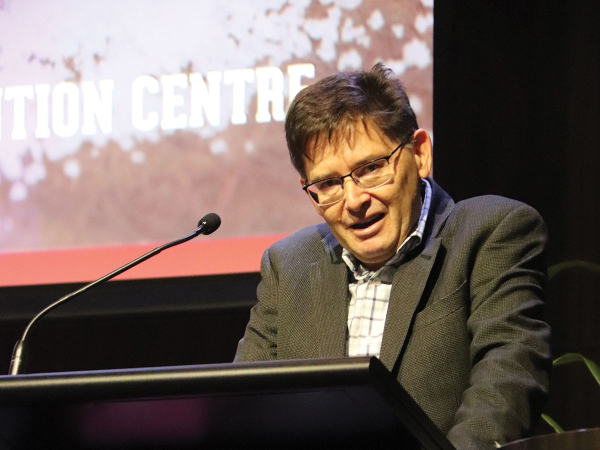
This from retiring managing director of Greenlea Meats Tony Egan, speaking to Rural News at the recent Meat Industry Association (MIA) conference in the capital. He says in the past processors were suspicious of each other and there was minimal cooperation.
At the conference, all the keynote speakers praised Egan for his contribution to the sector over more than 30 years. The Egan family-owned company Greenlea Meats was sold to the Japanese meat company ANZCO – a company founded by NZ entrepreneur Sir Graeme Harrison in the 1980s.
At the conference, Egan was singled out by MIA chair Nathan Guy and Minister of Agriculture Todd McClay, both of whom noted his outstanding contribution to the meat processing sector over three decades. They noted in particular the invaluable contribution he made as a member of the MIA Council and other sector groups of which he was a member.
McClay says Egan has made not only an exceptional contribution to the meat sector, but also his family’s benevolent contribution to society, particularly in the Waikato, including supporting the local rescue helicopter.
Egan was recognised for these efforts in the New Years Honours List when he was awarded ONZM, and McClay says he was privileged to be there for that occasion at Government House.
Egan says he’s the only casualty of the change of ownership to ANZCO. He says all the staff in the company will retain their jobs, but he will step down from his role as CEO of Greenlea, although he will retain a place on the board.
“For us it’s about succession planning and continuity for our staff. ANZCO is a very good company and they have been in NZ for about 30 years and have invested a lot here. They are a much bigger company and that brings real advantage for scale and they have great market access into Japan and in other places. For us it was a chance to align with them and extract ourselves from the industry in the knowledge that staff were going to be looked after,” he says.
According to Egan, Greenlea will run as an independent entity, but will be coordinated under the ANZCO umbrella organisation. Egan says ANZCO will not want to tamper with Greenlea too much because they realise that it is a very successful company and they will be keen to understand why this is so.
“I think this a really good approach,” he says.
Being based in the strongly dairy Waikato region, Greenlea is naturally a major processor of prime beef, selling much of this to Europe, China, the USA and the Benelux Union ‘countries.
A Humble Beginning
The Egan meat processing empire had humble beginning more than 80 years ago in a little butcher s shop in Gisborne.
Peter Egan, Tony’s uncle, worked in that shop in the 1960s but moved to Hamilton in 1993 to establish Greenlea’s first meat processing plant. They later bought another plant in Morrinsville.
As for Tony Egan, he was boarder at St Patrick’s College Silverstream and when he left school he briefly studied for the priesthood at the Greenmeadows seminary. He later left and then, as he rather casually notes, got a couple of degrees, went overseas, and taught for a year at St Pats Town. And then entered the meat industry, becoming the CEO of a strong family company that in his words is “big enough to achieve but still small enough to care”.
Reflecting on his time in the meat industry, Egan notes the massive changes that have taken place. At his early meetings with other processors, he says he couldn’t work out why no one was saying much around the table.
He says he then realised the real meeting was probably taking place in the lounge bar at the hotel they were staying in.
“These days there is much more willingness to address issues front on and we have seen a lot more integration of females into the industry and younger blood coming in. That has made the whole dynamic much more productive. Now I see a new vibe coming in and you could feel it at the MIA conference,” he says.
Egan says the specifications of meat plants now are huge they are basically extracting more value than ever before and continuing to evolve.
“While it’s challenging, technology along with a highly skilled workforce is helping us be competitive in the various markets we supply.
“As for me, thirty-five years later, I am back to being that frustrated arts student,” he says.