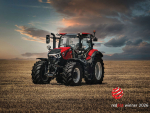
Case IH Unveils Next Generation Puma Series Tractors
Case IH has unveiled its redesigned next generation Puma Series tractors, said to offer improvements in connectivity, operator comfort, fuel efficiency and drivability.
 increase font size
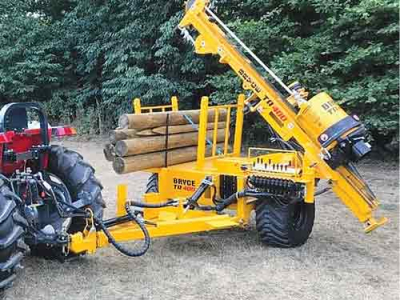 Bryce Suma's TR 400 post driver can be used on small or even ‘elderly’ tractors.
Most heavy-duty post drivers require a heavy-duty or substantial tractor to carry the implements on the three-point linkage.
However, a new design from Scottish fencing equipment specialist Bryce Suma sees the arrival of a post driver designed for more modest power plants.
The TR 400 is a trailed design that can be used on small or even ‘elderly’ tractors. The only real proviso is the need for an an oil flow of 25 to 30L/min to lift the 400kg monkey at a reasonable speed.
Like all Bryce Suma machines, the TR 400 has a two-stage telescopic design and a drop of 3.6m. Its patented auto-tele mast allows a choice of hammer stroke without adjustment.
The layout is also said to offer a reduced overall height, avoiding contact with overhead wires or tree branches. It also can be angled during transport for even better clearance.
A robust chassis has a drawbar set-up that allows the unit to jack-knife up to 90 degrees to help get into tight corners or awkward areas.
It also has storage space for up to 20 strainer posts, 100 round or square fencing stakes or 10 rolls of netting. There is also a storage container for a chainsaw or tools, with an additional tray on the drawbar next to the hydraulic control bank. Hydraulic stabilising legs extend from the frame, near the off-side wheel and the bottom of the mast, to complement a hydraulic set-up with mast side-shift and two-way vertical alignment. Additionally, back-shift and side-shift allow the operator to precisely position the mast or the integral swing-around rock spike.
For durability, the TR 400 also has a patented greasing arrangement for the mast: this lubricates both sides of the mast without the operator having to climb onto the machine frame.
Case IH has unveiled its redesigned next generation Puma Series tractors, said to offer improvements in connectivity, operator comfort, fuel efficiency and drivability.
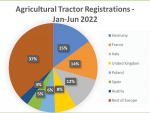
A total of 108,800 tractors were registered across Europe in the first six months of 2022, with 31,900 tractors of 37kW (50 hp) and under and 76,900 of 38kW and above.
Choosing the right new vineyard tractor is an important decision, given the major capital outlay.
Recently released in Europe, with expected delivery yet to be confirmed for New Zealand, the new Valtra A series tractors see a range of new transmission options that will get those looking for a compact workhorse.
New Zealand tractor sales finished 2020 on a strong note, with December sales up 18.4 % on 2019.



Now in its fourth year, the 2026 Fencing Industry Awards, formed part of the proceedings of the FCANZ Conference, held in Nelson during August.

DairyNZ deputy chair Cameron Henderson has been re-appointed unopposed for another term.
OPINION: The stats speak for themselves.
Farms across the upper North Island are trialling different pasture mixes as part of a research programme that aims to build greater resilience into farming systems.
Election years are always a concerning time for farmers, according to DairyNZ chair Tracy Brown.
The Ballance Farm Environment Awards are coming to the West Coast of the South Island.