Farmers Urged to Cut Fuel Use as Diesel Shortages Bite
Respected farm accountant Pita Alexander says with the present fuel crisis there are many ways farmers can reduce their consumption of petrol and diesel.
 increase font size
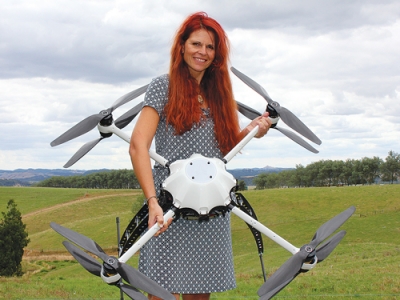 Linda Bulk, sales director at Aeronavics NZ, displays one of the many UAVs now available for on-farm use in New Zealand.
We've all seem remote controlled helicopters for the kids at the airport duty free counter, but commercial UAV’s take the game to a whole new level and can offer some tangible benefits for agriculture or horticulture.
Commercial units fall into two distinct camps, either fixed wing or multi-rotor, each offering benefits and disadvantages.
Fixed wing machines have higher payload capacities, but need larger areas for takeoff and landing and can be difficult to transport – whereas multi-rotor designs tend to be easier to transport, need only a small area to deploy, but have more limitations on payload.
The subject of fuel also kicks in with regards to load capacities, range and flying times.
The key point, as with the trusty farm tractor, is what are you going to put behind – or in this case – underneath the UAV to give you information? The options include real time video, near infra-red, thermal or multi-spectrum cameras.
Each has something to offer, but what does it mean in terms of practical on farm use?
On a livestock enterprise there is a potential to save time and money. On the former, the old 80:20 rules applies with regards to looking for problems then dealing with them.
A UAV with a real-time video camera can cover in 15 minutes a farm that might take 90 minutes on a quad. This has the potential to reduce the distance travelled on the typical farm vehicle by many thousands of kilometres a year, save a great deal of fuel and reduce the likelihood of accidents.
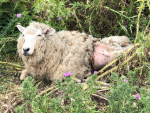
It could patrol the water troughs looking for leaks, monitor and muster sheep and spot any cast ewes. In financial terms alone, saving 40 sheep at a value of $300 each realises $12,000 per year.
From a management perspective on the same farm, it could be used to check for weeds or pests, or to map the farm or the drain layout in a about an hour, compared to hiring a helicopter for half a day at around $1600.
In arable or cropping situations, it has the same benefits of overlooking crops for weeds and pests, and multi-spectrum cameras can be used to look for particular traits such as crop densities, plant populations and specific diseases. With a multi-rotor unit, there is even the option of stopping, hovering and zooming in on particular targets and targeted precision spraying in orchards and vineyards.
These units also have potential, especially on very large land areas, to look at normally inaccessible areas, thereby improving safety, surveying areas that have been damaged by weather or fire and using thermal imaging to find missing livestock or people.
So the question many will ask is: “I struggle to set the video recorder or tune my car radio…. will I need to employ a fourteen year old to fly this thing for me?”
The answer is you’ll probably need a little training from the supplier or your teenager, but if you have a bit of a handle on the humble computer you should be ok. Most machines can be flown manually, but can also be pre-programmed to fly a pre-prescribed route by GPS and even return home if fuel starts to get low.
The rules
Respected farm accountant Pita Alexander says with the present fuel crisis there are many ways farmers can reduce their consumption of petrol and diesel.
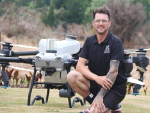
Bradley Wadsworth lives on the family farm – Omega Station – in the Wairarapa about 30 minutes’ drive east from Masterton.
Felton Road Wines is using an electric drone sprayer to apply organic fungicides and monitor crops, cutting emissions and transforming management.
Use of agricultural drones by contractors in New Zealand is soaring.
While we are seeing more and more drones being used in New Zealand agriculture, we’re some way behind the US, where in places like the Midwest, the drones are certainly bigger than Texas.

Penske Australia & New Zealand has appointed Stephen Kelly as the general manager of its Penske NZ operations, effective immediately In this role he will oversee all NZ branch operations, including energy solutions, mining, commercial vehicles, defence, marine, and rail, while continuing to be based at Penske’s Christchurch branch.
According to the latest Federated Farmers-Rabobank Farm Remuneration Report, released today, farm worker pay growth has levelled off after a post-Covid period of rapid growth.
The Climate Change Commission has recommended maintaining the current New Zealand Emissions Trading System (NZ ETS) settings but warns of a potential unit shortfall as early as 2028.
The Conservative Party warns that the upcoming free trade agreement between New Zealand and India may prioritise increased labour mobility while offering limited reassurance for New Zealand workers.
Southland District Council says it is actively managing the impacts of the current fuel supply challenges to ensure essential services across the district continue to operate safely and reliably.
A large crowd turned out for the last of the field days of the three finalists in this years Ahuwhenua Trophy to determine the top Maori horticulture entity in Aotearoa New Zealand