Hort systems must meet expections of the future
Plant & Food Research has just begun a major research programme focusing on designing horticultural growing systems to meet the expectations of society in the future.
 increase font size
Aquaculture is the fastest-growing animal production sector, experiencing global annual growth rates of 6% over the past 15 years.
Aquaculture production recently exceeded wild harvest of aquatic foods, and according to the FAO, consumption of aquatic food has risen steadily over the past 60 years to an average of 20 kg/person/year.
Aquatic animals are nutritious, there are a diverse range of species and product opportunities, and the feed conversion efficiency of ‘cold blooded’ aquaculture stock is generally superior to that of terrestrial agricultural animals.
It’s attributes like these that have investors, landowners and farmers increasingly interested in the potential for aquaculture production as a method to diversify land and water use in NZ.
As part of the Our Land and Water National Science Challenge, PAMU commissioned AgResearch and Plant & Food Research to consider how a Canterbury dairy farm might adapt their land and water resources to include aquaculture production.
Despite abundant freshwater resources there is very little land-based aquaculture production in our country to use as case studies for diversification.
And while there are many international examples of integrated agri-aquaculture systems, it’s difficult to directly apply overseas models at home, for the same reasons many farming systems tend not to be directly transferrable between nations.
There are numerous biological, geographic, environmental, economic, political and cultural factors which means there needs to be some home-grown adaptation and innovation to make integrated agri-aquaculture systems work for our corner of the world.
Aquaculture will thrive if we can do it more efficiently and with a lower carbon and nutrient footprint than everyone else, and if we create products with unique selling points and market value that cannot be replicated elsewhere.
Using the water twice – fertigation using aquaculture waters
One of the best ways to develop low nutrient footprint production is to integrate aquaculture outputs into the wider farming ecosystem.
By designing systems that utilise the effluent water from aquaculture systems for agricultural fertigation is a great example of integrated production.
Aquaculture effluent waters tend to have fewer dissolved organics than dairy farm effluent, and the nutrient profile is generally well suited to rapid uptake by plants. In addition, having aquatic stock reared in tanks, ponds or raceways means all nutrient outputs are contained and readily transportable in effluent waters.
The challenge to making aquaculture fertigation work well is having sufficient storage capacity for effluent water so that it can be used when needed.
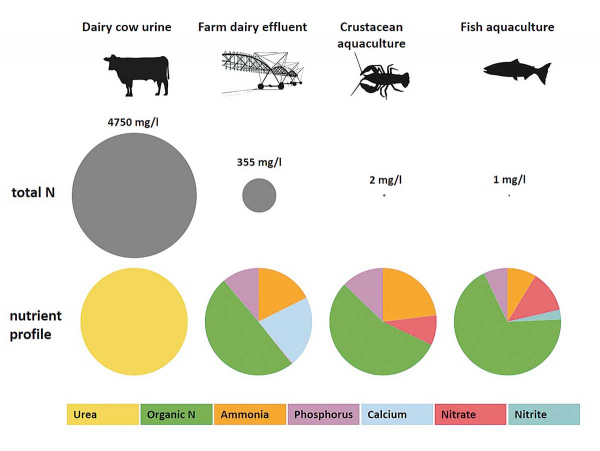
Figure 1 gives an overview of the concentration and types of nutrients in aquaculture waters compared with those from farm dairy effluent and dairy cow urine. The total N concentration of effluent from aquaculture sources is much lower than dairy effluent point sources.
The nutrient composition of aquaculture effluent differs from that of dairy effluent in some ways (specifically in the calcium and nitrate concentrations), but is similarly dominated by organic nitrogen, ammonia, and phosphorus, providing opportunities for fertigation.
The organic nitrogen component of aquaculture effluent is mostly comprised of suspended solids such as uneaten food, faecal material and microbial flocculent, and if necessary these can be concentrated and removed via filtration, flocculation, foam fractionation and hydrodynamic concentration.
The ability to capture and re-direct all effluent discharges from aquaculture systems gives farmers the potential to fully control and integrate nutrient flows from aquaculture into agriculture.
Plant & Food Research has just begun a major research programme focusing on designing horticultural growing systems to meet the expectations of society in the future.

“Aged wine” may have an alternative meaning in future, as researchers learn more about how individuals process and perceive aromas while tasting wines.
Plant & Food Research’s Vaughn Bell has seen a lot of mealybugs in his time, but even he was stunned to see photos of infestations in Marlborough this past vintage.
One aspect of the Pinot Noir Programme is taking a reductionist approach to conduct research on individual berries and is set to make scientific history.
With funding of $10.3 million, the five-year Pinot Noir research programme is already breaking ground in terms of knowledge of this fickle grape and capricious wine.


Pāmu has released its FY26 Integrated Annual Report, reporting a Net Operating Profit of $113 million, more than double the $49 million recorded in FY25.

Meat Industry Association data, released alongside the Red Meat Sector conference in Wellington, shows export value climbing across the US, China, UK and Canada.
Applications are set to open for the 2027 Zanda McDonald Award, a trans-Tasman award recognised for identifying and fast-tracking talented young leaders in agriculture and agribusiness.
The Royal New Zealand College of General Practitioners (the College) and Hauora Taiwhenua Rural Health Network are calling for investment in a proposed new training pathway for rural GPs, warning that many rural practices are struggling to recruit while a large share of the existing workforce nears retirement.
Federated Farmers has called on Central Otago District Council (CODC) to drop or vote down a plan to truck sludge from Alexandra and Cromwell to farmland near Lauder, warning it would compound an "outrageous" situation created by a separate council's decision weeks earlier.
Synlait has swung to second-half profit as operations stabilise, but the dairy processor still posted a $75.4m annual loss.