
PGG Wrightson Revenue Tops $1.1b as Profit Jumps 46%
After delivering a strong financial year, rural trader PGG Wrightson says the coming months will depend on customer confidence and weather.
 increase font size
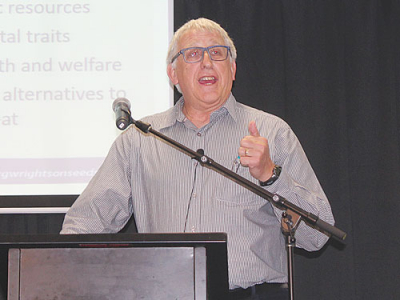 PGG Wrightson Seeds’ Derek Woodfield.
Plant breeding research for pastoral farming has shifted from the likes of AgResearch to private institutions, says Derek Woodfield, GM research and development, PGG Wrightson Seeds.
We are also seeing the advent of more disruptive technology – things that have raised the bar, Woodfield told this year’s NZ Institute of Primary Industries Management conference.
That fundamental shift to more private investors has brought a focus on species able to generate an economic return for those companies.
Although species that are more ‘niche’ in NZ still attract investment, this country may not always be the first target of the breeder.
But there is the advent of the Forage Value Index (FVI) to give farmers confidence in the products and the returns they are likely to see.
The FVI is important; it is only in the dairy industry at the moment but there are moves to develop the FVI for sheep and beef systems and through one of the Beef + Lamb NZ lead partnership bids.
The FVI is there to provide confidence, Woodfield said. Rural companies will not survive if “we are not providing better and consistent products that work onfarm and add value”. The FVI provides as opportunity to benchmark those forages.
PGG is investing alongside industry. “In pastoral farming we would not be able to get there in genomic selection on our own. Private investment is being made alongside DairyNZ and others.
“In saying that, the fundamental drivers of forage breeding in NZ are unchanged: you must be able to deliver quantity, quality and resilience of those forages for those farming systems,” Woodfield says.
“In the last 8-10 years we have shifted our focus to trying to add environmental traits that will ensure we have licence to operate in terms of greenhouse gas emissions and nitrate leaching targets but that also can address the fundamental nature of climate change and that resilience. You only have to look back 10 years... you can see the changes already happening in Europe, and we use those as a lead in to go after targets here.”
PGG Wrightson Seeds is currently investing about $15 million a year annually in NZ in forages. They have long term partnerships with AgResearch in core breeding and grasslands innovation, with Lincoln in developing new and novel endophytes via the endophyte innovation programme and with Plant and Food in forage innovation such as brassicas onfarm now.
“We see that as critical to not only having a good strong breeding programme but also being able to link back to science and then provide a pipeline for those innovations to come through.”
With ryegrass they are seeing a 7.6% year-on-year gain in dry matter yield. The FVI provides readings on the value of different cultivars in dairy systems. There is a wide range from old cultivars with somewhat negative returns through to new cultivars yielding at least $600/ha.
White clover is consistently showing about a 1% gain per year; red clover shows increased persistence under grazing and some novel uses of that in farming systems. And the forage brassicas are showing improvements in quality and yield, etc, through being able to eliminate weeds with the PGG Wrightson management technology Cleancrop.
Plantain and chicory have been domesticated in NZ and have had the greatest impact in agriculture and farming systems here.
NZ has been the ‘beaver’ in endophytes, Woodfield says. AgResearch has led the charge. A recent report for MBIE suggests the total value of the AR37 endophyte to the NZ economy is at least $2 billion over the lifetime of that patent – at least $100m a year in additional revenue from AR37 alone.
After delivering a strong financial year, rural trader PGG Wrightson says the coming months will depend on customer confidence and weather.
Strong competition and tightening supply have seen wool reach its highest prices paid at auction since 2011.
Last night saw the winners of the 2026 Beef + Lamb New Zealand (B+LNZ) Awards named at a gala dinner at Te Pae Christchurch Convention Centre.
A firm belief in the agricultural sector has kept the PGG Wrightson business going for 175 years, says chief executive Stephen Guerin.
Strong farmgate milk price is helping boost investment on farms, says PGG Wrightson chief executive Stephen Guerin.


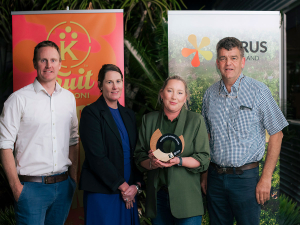
New Zealand's citrus growers were challenged to build their future on the value embedded in their fruit rather than the volume they produce, at Citrus New Zealand's annual gathering in Gisborne on 17 September.
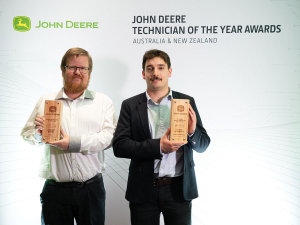
Leading John Deere technicians and apprentices from New Zealand and Australians were recognised at the recent sixth annual JD Technician of the Year Awards, held in Brisbane.
In Dacre, near Invercargill in New Zealand’s South Island, Bruce Dinnington is running a dairy operation unlike any other.
A free online platform aggregating governance vacancies across rural and regional New Zealand has been launched.
Environment Minister Nicola Grigg has announced details of a new rural plastics recycling scheme.
Agricultural drone operators say that a government decision to allow lower-risk drone work without certification won’t lower standards but drive innovation and efficiency.




