Concerns about the sensitive environment of the Kaipara Harbour prompted the top-performing drystock unit Te Opu to transition from sheep and beef breeding to a successful unit finishing bulls and lambs.
This gave the farm the flexibility needed to respond to the sensitive environmental challenges of its location on the Kaipara Harbour shores.
The farm is now a three year Beef + Lamb NZ environmental focus farm sponsored from several sources.
It is owned by equity partners Bryce Lupton and wife Aneta with Peter and Prue Vincent.
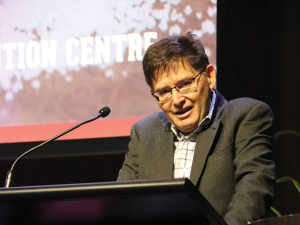
Lupton told a recent BLNZ field day that his great grandfather bought the farm in 1890 and it had been owned by the one family for 124 years. Three years ago the family sold the farm and the equity partners bought it.
The 392ha (360ha effective) property forms a private peninsula on the Kaipara Harbour near the Maungaturoto township.
The changes during the 30 years have been huge, he says. Maps from 1961 to 2015 illustrate these changes. Willows and poplars were planted for land stability. Mangrove areas were increasing because of sediment from the paddocks; sediment is the Kaipara’s major issue. They also fenced off their riparian areas.
“We changed from a breeding finishing unit to just a finishing and trading unit. That gave us a huge flexibility. Flexibility is needed to build a resilient farm business.
“To be sustainable you’ve got to produce a profit to reinvest back into the business to enhance it and give shareholders a return on their investment.”
They chose to do a land environment plan, starting with the farm and its biggest asset, the soils.
“You need to know your soil types, the characteristics of your soils, what their limitations are. That determines what stock you can and can’t run on them over periods of time without damaging them.
“You’ve got your soil types, your land classifications – what you should or shouldn’t be running on there to keep it in good condition. Our soils are wet then summer-dry so we can’t run heavy cattle.
“That’s where we steered into the sheep policy over winter. Winter finishing lambs – the country loves it and the sheep love it too. That is a policy which really sticks for us and our environment. Then we go into cattle over the summer autumn period.”
From the Land Environment Plan they identified areas needing action. The ‘to do’ list has a worksheet of high, medium and low priorities and areas that need fencing.
“It gives you an angle to start prioritising your work and then you start chipping away.”
Te Opu is a sensitive farm because “what happens onfarm goes straight into the harbour”.
“We have farms above and around us whose water flows past us as well. What they do and what we do is very important to the harbour.”
Trading as White Rock Hills Ltd the farm runs 35,000 lambs and 450 beef bulls.
They buy store lambs in April-May-June and sell in July-November at 18-19kg carcase weight.
For Friesian bull finishing they buy 420-480kg lwt by 20-22 months of age; they avoid a second winter to avoid pugging. The bulls are grazed in a 60ha intensive grazing system and 70ha cellular system. The systems are structured with firm target disciplines in place.