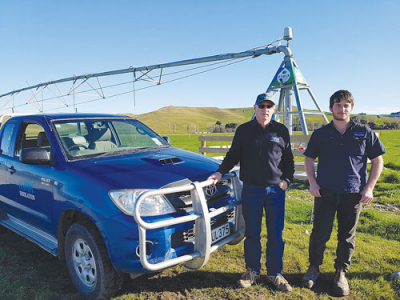
When William Bragg left school all he wanted to do was work with horses, but he soon realised this passion would not make him a fortune.
Bragg was working on his father’s dairy farm milking and herding cows in Waimate in 2014 when his father heard about a possible job at local irrigation firm Kirk Irrigation and suggested he apply for it.
Bragg, now 25, says he always liked the idea of design and engineering and he had excelled at technical drawing at school.
“I thought, ‘I have no experience in irrigation, but what’s the worst that could happen?’ So I went in to see them anyway, and the rest is history.”
Bragg’s boss Rob Kirk, of Kirk Irrigation, says it was obvious right from the start that William had huge ability.
“He was clearly a person of huge potential. He picks things up so quickly. There’s a lot of maths and physics in irrigation design. You need to know about computers and hydraulics and soil moisture, among other things, and do all sorts of calculations and modelling.
“When the course came up with Irrigation New Zealand, Will had been with us 18 months, I thought it was a good thing for him and a good thing for the company. He was already way ahead of where I’d expected him to be after such a short time.”
Bragg studied for 18 months for the first ever NZ Certificate in Irrigation Design, and graduated last month with 14 other students at a ceremony in Christchurch.
NZ is the only country with a national qualification in irrigation design, something Irrigation NZ and the irrigation industry are proud of.
Irrigation NZ project manager Steve Breneger says NZ is leading the world in irrigation design training.
“The course is nationally recognised and very rigorous. It tests the students’ ability to design infrastructure, and challenges them to identify and mitigate possible effects on the environment.
“There is increasing demand for project managers and qualified designers in the industry, particularly with the increasing amount of compliance reporting required to improve freshwater management and monitoring.”
Students design systems from beginning to end, starting with identifying customer needs, environmental impact, integrating technologies then designing an efficient irrigation system.
Bragg enjoys visiting customers on their farms to understand their requirements and see the process through to installation.
He remembers when his first irrigation system went live -- a small K Line system, the flexible hose line sprinkler system invented by Rob Kirk’s brother Jon.
“I got to do the final installation and push the button myself. It was extremely satisfying and everything worked as it was meant to. When I went home my partner wondered what I was so excited about. Sounds a bit silly but I was so excited.”
Bragg now leads projects from start to finish.
Kirk believes William has a big future in the industry.
“He joined the irrigation industry when compliance requirements were increasing,” he says. “The course has lifted him to another level.”