One and One Don't Make Three
OPINION: Since when did one and one make three? Who didn't smell an elephant-sized rat when our leaders decided to give $60 million to save the cement factory in Northland?
 increase font size
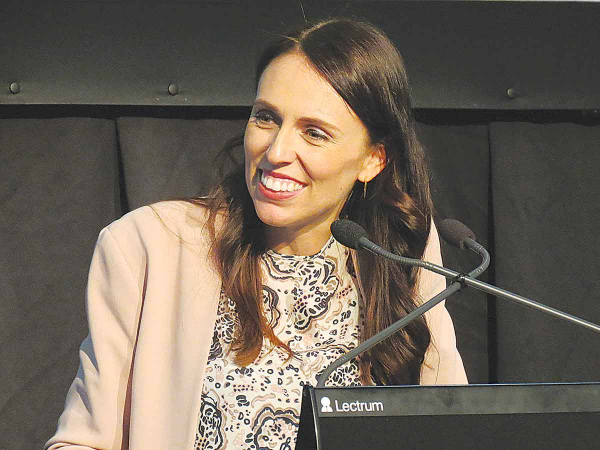 Prime Minister Jacinda Ardern.
OPINION: Jacinda breezed in to town recently, with Damien in tow.
Following his triumphant decapitation of the live export trade, Damien was presumably looking for another prospering rural enterprise to put the taiaha into. But mother nature’s drought is successfully doing the job for him. So, he would have left disappointed.
The PM greeted local councillors and discussed the success of the mayoral task force for jobs, which has created 12 new positions. Loud applause. Then she visited a regenerative dairy farm.
What she did not do was look out the window of the ministerial BMW and say: “My God! You are having another massive drought leading to the massive long term economic and social damage to the entire region. We must act on water storage at once!”
Which, to be honest, was unsurprising but sad. Because just up the road is the much abused, shovel-ready Makaroro dam – a vital component of the Ruataniwha Water Storage Scheme. The RWSS, some may remember, was proposed by the HB Regional Council in 2010. It would generate 6.5 megawatts of renewable energy – worth $3 million at 2010 prices. It would increase the summer low flows in the Tukituki river, irrigate 25,000 hectares of land, create 3,000 sustainable jobs in the sustainable primary sector – with environmental safeguards comprising the tightly-regulated land use under Plan Change 6. The dam was kyboshed by a political party, set up and funded by a Hastings orchardists’ lobby. They said that money on water storage should be spent in their patch, not down the road.
Their representatives, calling themselves Rex and the Romans, included an ex Labour Party MP and cabinet minister Rick Barker. At first, those four councillors supported the dam. Then in 2016, without any explanation, they became vehemently opposed. Garnering support from green groups nationwide, they steamrolled the dam proponents and in 2018, after spending $24 million of public funds, the project was cancelled.
Unfortunately, the problem remained and they set up another group to look for an answer. This group reported back in September last year. After further exhaustive research, they declared that the RWSS was still far and away the best long term solution for the current and future water crisis!
The council ignored them. When Covid and the first drought hit, shovel-ready projects became the rage. The RWSS was never considered – because of the political embarrassment it would cause if, God forbid, our leaders were to admit they were wrong. So much for the climate crisis, proclaimed by both the Government and the regional council. Instead of a dam generating hydroelectricity, we import 275,000 tonnes of coal to fire up Huntly and millions of litres of diesel to crank up Whirinaki. Sorry, planet earth!
In the meantime, HBRC – with Rick Barker as deputy chair – has decided that a water storage dam in Hawkes Bay is a good idea indeed. As long as it is near Hastings. And low and behold, HBRC is currently investing in plans for a 3-million cubic metre dam to address water security on the Heretaunga plains.
Rick won’t be supervising the project, as he was recently appointed chair of the West Coast DHB. Curiously, they couldn’t find someone closer to Hokitika to do the job!
Looking out the other window, as she rolled past understaffed dairy farms, the PM might have noticed leagues of unpicked apples and distraught rural contractors kicking idle farm machinery.
“My goodness,” she might have cried. “We’ve let in movie stars, film technicians, Russian fishermen, Russian oligarchs and others of that ilk. We must also let in the RSE workers, milk maids and tractor drivers upon which our economy relies. For they will power our debt-riddled economy back into prosperity.”
But she didn’t. Nary a whisper. So, her visit was disappointing. Confirming that dogma dictates decisions, while reason runs for cover. Grass doesn’t need water. Tractors don’t need drivers. Regenerative farming makes Lincoln redundant. Maori wards will make gangs evaporate. Pine forests make air travel harmless. Nevertheless, we pray that rain and sanity may one day return to us here in drought land.
OPINION: Since when did one and one make three? Who didn't smell an elephant-sized rat when our leaders decided to give $60 million to save the cement factory in Northland?

OPINION: Your old mate hears an international incident is threatening to blow up the long-standing Anzac alliance as Kiwis and Aussies argue over who wants new Australian resident and former NZ Prime Minister Jacinda Ardern.
OPINION: Did former PM Jacinda Ardern get fawning reviews for her book?
OPINION: After Jacinda Ardern and Labour were asked to form the government following the 2017 elections, Federated Farmers sent an email out to its executives asking if any of them had a working relationship with any Labour MPs. The answer was no one did.
OPINION: It's been reported that former New Zealand Prime Minister Jacinda Ardern will work alongside leaders from Conservation International to advocate for climate action and better treatment of the environment.



LIC shareholders have elected a new North Island representative to the co-operative's Board, along with five representatives to its Shareholder Reference Group (SRG), following the company's Annual Meeting held in Invercargill.
Farmers across parts of Southland and South Otago are continuing to deal with difficult conditions after a prolonged run of wet weather, with pressure building around feed supply, stock management, pasture damage, farm infrastructure and everyday workloads.
Federated Farmers says it welcomes Labour's commitment to reviewing the Sharemilking Agreements Act, calling on other major parties to do the same.
For Canterbury dairy farmers Sian Meijer and Rick Wobben, wearable technology has become one of their most valuable on-farm tools - helping manage 1850 cows across an expansive, high-performing dairy operation while improving efficiency, mating outcomes and day-to-day decision making.
Fonterra has unveiled its annual results for the 2026 financial year, posting $27 billion in revenue and close to $20 billion returned to New Zealand farmer owners and unit holders.
The first major update to the Dairy Cattle Code of Welfare in more than a decade has been released, marking what DairyNZ describes as an important step in ensuring animal welfare standards continue to evolve alongside scientific evidence and on-farm realities.