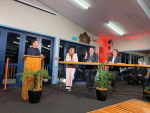
Rural Vote Debate on Q&A: Substance or Just Platitudes?
It was billed as a chance for all the political parties to woo the rural vote, but question marks hang over just how effective this was.
 increase font size
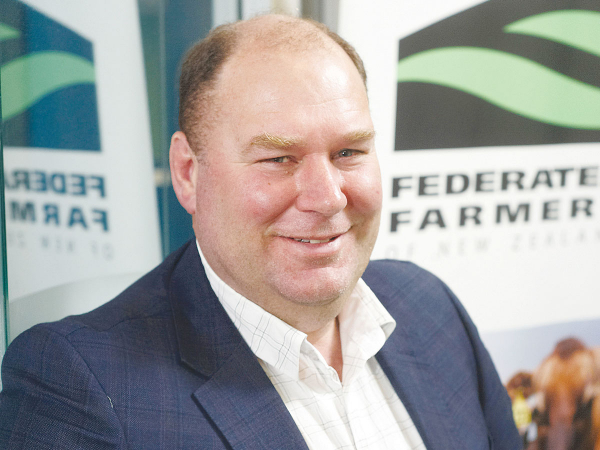 Andrew Hoggard
OPINION: Federated Farmers joins the many council-elected representatives and citizens up and down the country urging the Government to go back to the drawing board on reform of its three waters delivery.
It's clear that billions of dollars of investment are needed to get drinking water, stormwater and sewerage infrastructure up to scratch. However, there are too many flaws and question marks over the proposed four new mega entities for the Government to just press ahead.
A range of deep concerns with the proposed model have been raised in the provinces, chief among them the risk rural voices and needs will be swamped in the enlarged set-ups.
Right now we have a direct say in the appropriate level of investment and priorities for water infrastructure via our local council. If our elected representatives don't deliver, we can eject them at election time - and they know it.
That accountability is significantly watered down with the arms-length governance arrangements now proposed. Councils and iwi get to appoint a panel, which in turn appoints another panel, which selects members of an unelected board.
The complexity of rural water scheme ownership and operations is creating uncertainty in many rural communities and the role of Taumata Arowai and the water service entities needs to be clarified.
Serious questions have also been asked about the estimated costs and benefits of larger water authorities. Experience has shown bigger is not always better.
While it's also true that turkeys don't vote for Christmas. Some councils and councillors might have an eye on their future existence if water services are removed from their purview. Federated Farmers argues the Government's local government, Resource Management Act and three waters reforms are back to front.
The three waters and RMA reforms should be parked until after the Government's current review into the future of local government.
Advacing these huge and costly reforms prior to this review is like putting the cart before the horse.
September 30 was the deadline for councils to give feedback on what changes would need to be made to the three waters model for them to 'opt in'.
Patently, with indications more than three quarters of councils are against or deeply concerned by the proposals, it would be extremely unwise and unfair for the Government to make them mandatory.
New Zealanders need and deserve the time to debate these crucial water services issues.
There is no case for rushing ahead and hoping for the best.
Andrew Hoggard is Federated Farmers national president.
It was billed as a chance for all the political parties to woo the rural vote, but question marks hang over just how effective this was.
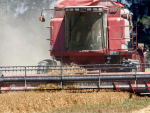
Mid Canterbury Federated Farmers arable chair, Bevan Lill, said Beef + Lamb NZ data indicated that for the last six years, the average arable return on investment was about 0.8% while inflation ran about 4% - so the average arable farm was going backwards at about 3% a year.
For the first time in a quarter of a century, Federated Farmers has something positive to say about the Labour Party’s climate change policy leading into a general election.
Rural leader Mark Hooper has been appointed as an independent director to the NZPork board, bringing extensive farming, governance and advocacy experience to the role.
There's been widespread support from the primary sector for the Government's announcement on changes to freshwater farm plans that come under the Natural Environment Bill, which is now set to replace the existing RMA.


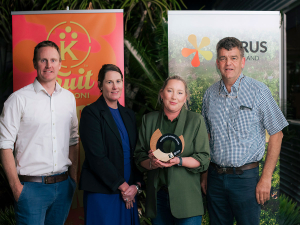
New Zealand's citrus growers were challenged to build their future on the value embedded in their fruit rather than the volume they produce, at Citrus New Zealand's annual gathering in Gisborne on 17 September.
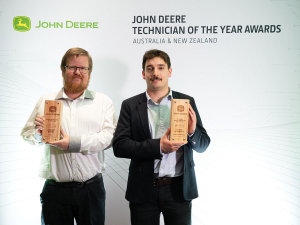
Leading John Deere technicians and apprentices from New Zealand and Australians were recognised at the recent sixth annual JD Technician of the Year Awards, held in Brisbane.
In Dacre, near Invercargill in New Zealand’s South Island, Bruce Dinnington is running a dairy operation unlike any other.
A free online platform aggregating governance vacancies across rural and regional New Zealand has been launched.
Environment Minister Nicola Grigg has announced details of a new rural plastics recycling scheme.
Agricultural drone operators say that a government decision to allow lower-risk drone work without certification won’t lower standards but drive innovation and efficiency.