BCS Targets: Why Body Condition Score Matters at Calving
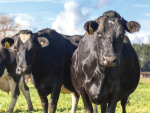
Body Condition Score (BCS) is a critical element in managing the health and reproduction of the dairy herd.
 increase font size
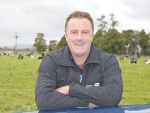
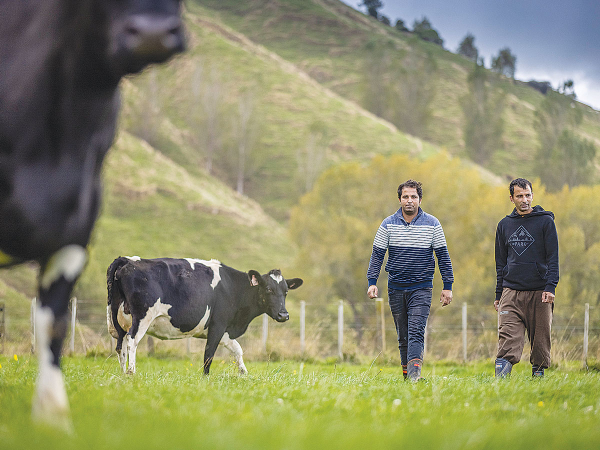 Brothers Manoj Kumar (right) and Sanjay Kamboj on their Eketahuna farm.
From early July, it will be all hands-on deck for award-winning dairy farming brothers Manoj Kumar and Sumit Kamboj as they start welcoming their first winter calves of the season.
The 50/50 sharemilkers, who recently won the national Share Farmer of the Year award, expect around 760 calves on both Eketahuna properties which they manage along with their six-strong team.
Front of mind for both brothers is making sure all new-born animals are traceable and their details recorded in the National Animal Identification and Tracing (NAIT) system.
"We use LIC's dairy participant code tags as we know these tags numbers are aligned to NAIT and can be matched in the NAIT system. Once we've tagged the animals, the tag numbers are recorded in MINDA [livestock management system] and that synchs throuhg to the NAIT account for registration," says Kumar.
The brothers keep tabs on the NAIT accounts for the three NAIT locations they manage. When they first took over the sharemilking duties, they discovered that the NAIT records needed updating.
"Some of the herd were not registered in NAIT and the movement records were also requiring attentio. We called the OSPRI Contact Centre, and they were brilliant and very helpful getting the NAIT accounts to reconcile so we could become NAIT compliant."
On-farm biosecurity starts with making sure new-born calves are tagged and registered in NAIT within 180 days of birth (six months) or before their first movement off-farm, whichever happens first.
Kumar believes NAIT is not difficult to keep on top of and says it is essential for supporting disease management.
"I believe we are all learning from the M. bovis outbreak and how traceability has played a part in managing and containing it. There is also more information available about keeping your animals compliant with NAIT."
This season the plan is to hold on to most calves and to manage them at a recently acquired run-off block near both farms. Kumar said they wanted to build equity with their livestock and breed replacement heifers.
"We'll keep most of our bull and heifer calves and may sell some when they reach 100 kilos or just before finishing."
When moing animals on and off-farm, both brothers choose to scan the animal tags using a Tru Test scanner. This saves time and is particularly efficient for transporting animals off-farm.
"When we send our animals to AFFCO, they can make the NAIT movement on our behalf as they are an NAIT accredited entry. So we just have to provide an animal status declaration form (ASD) along with the animals being moved."
Body Condition Score (BCS) is a critical element in managing the health and reproduction of the dairy herd.

OPINION: It's no surprise that "world-class biosecurity" continues to dominate as the top priority for agribusiness leaders, holding the number one spot for the 16th consecutive year in KPMG's latest agribusiness report.
Giving calves the best possible start to life has been shown to boost growth and resilience.
Moving Day (June 1) is just around the corner and farmers who are moving farms with the herd are being urged by Ospri to start preparations now.
The first weeks of a calf's life quietly shape the future of the entire herd.



LIC shareholders have elected a new North Island representative to the co-operative's Board, along with five representatives to its Shareholder Reference Group (SRG), following the company's Annual Meeting held in Invercargill.
Farmers across parts of Southland and South Otago are continuing to deal with difficult conditions after a prolonged run of wet weather, with pressure building around feed supply, stock management, pasture damage, farm infrastructure and everyday workloads.
Federated Farmers says it welcomes Labour's commitment to reviewing the Sharemilking Agreements Act, calling on other major parties to do the same.
For Canterbury dairy farmers Sian Meijer and Rick Wobben, wearable technology has become one of their most valuable on-farm tools - helping manage 1850 cows across an expansive, high-performing dairy operation while improving efficiency, mating outcomes and day-to-day decision making.
Fonterra has unveiled its annual results for the 2026 financial year, posting $27 billion in revenue and close to $20 billion returned to New Zealand farmer owners and unit holders.
The first major update to the Dairy Cattle Code of Welfare in more than a decade has been released, marking what DairyNZ describes as an important step in ensuring animal welfare standards continue to evolve alongside scientific evidence and on-farm realities.