DairyBase and MINDA Link Up to Cut Farmer Paperwork
Farmers can spend less time on paperwork, thanks to a new data sharing agreement between DairyNZ’s DairyBase and LIC’s MINDA software.
 increase font size
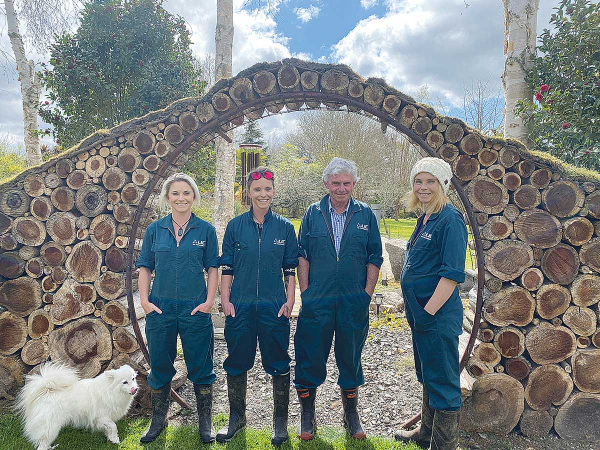 Left to right with dad Paul McCarthy are daughters Laura, Anita and Erin.
Each year about 900 of LIC’s qualified AB technicians (AB techs) visit farms in their local area, artificially inseminating thousands of cows between September and January.
Their aim is getting cows pregnant to continue-on in their farmer’s milking herd and produce the next generation cow.
LIC’s AB technicians are paid at a piece rate meaning they get paid for every insemination they complete so good money can be made in a relatively short period of time. However, it’s dependent on experience, ability, the amount of time they’re able to work and where they live in New Zealand. It’s a varied and rewarding role that attracts people from all walks to life and LIC is now seeking recruits for the coming season.
The ability to earn extra money in an industry he loves was a strong motivator for one long-serving LIC AB tech Paul McCarthy, who first trained in 1978 as a 20-year-old (seeking to supplement the income he was earning as a first-time sharemilker). He’s now been working for LIC for nearly 40 years.
Paul and his wife Johanna own a 134ha dairy farm in Galatea in the eastern Bay of Plenty but Paul retains his work as a seasonal AB tech because he loves it, and because it’s somewhat of a family vocation.
“My brother-in-law works as an LIC AB tech near Ashburton, with the job becoming and even bigger family affair since my three youngest daughters – Anita, 31, Laura, 30, and Erin, 28 – all fully-qualified as AB tech’s with LIC about five years ago,” he says.
Paul says that there is financial gain to be made, however it’s no easy ticket getting there, especially if you’re working two jobs as Anita and Erin are.
“Laura only just got through because there’s a height and length-of-arm criteria for the job. But she just got in and did her apprenticeship in the South Island where you’re dealing with large Friesians and she was able to inseminate those big cows. She’s a very determined person.”
The training process
Trainees go through an initial two-week training course with LIC which includes working on an artificial cow and a visit to a freezing works to work on live animals. Next comes working as an apprentice for an entire mating season. If results are successful (and cows fall pregnant), the trainee then gets a group of farms to service themselves, with close support and monitoring by LIC’s team of AB supervisors and senior mentors.
“It’s only the AB techs who are genuinely passionate about their job that succeed, and they’re generally the same ones who carry good empathy for dairy farmers,” Paul says. “All young AB techs I know are immensely proud of their role in the dairy industry.
“But it’s not the easiest thing to learn. It’s hard on your arms and hands. It can be very frustrating and there are plenty of times you’ll ask yourself ‘what am I doing this for?’ but then one day it all clicks. Once you’ve got it, and you’ve handled the pressure of training, there’s a lot of pride there; it makes you feel good.”
Once trained AB tech’s can return to their role the following season, after taking a break over the Christmas and New Year period. Many do other essential work in the agriculture sector, or travel and work overseas in the interim period (although not under COVID-19) where New Zealand LIC trained and qualified AB techs are highly regarded.
Farmers can spend less time on paperwork, thanks to a new data sharing agreement between DairyNZ’s DairyBase and LIC’s MINDA software.
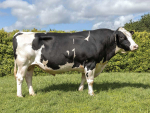
An LIC bull, Tronnoco AR Sadio-ET S3F, bred by Tony and Keri O'Connor of Tronnoco Farming Co Ltd near Timaru, has won the 2026 Mahoe Trophy.
Bovine Viral Diarrhoea (BVD) is estimated to cost New Zealand's dairy and beef industries more than $150 million every year, yet many of the tools needed to control it are already well understood. After more than 25 years in veterinary practice, Andrew Weir, animal health technical specialist at LIC, has seen firsthand the impact BVD can have on herd performance. We asked him about the role of persistently infected (PI) animals and the practical steps farmers can take to reduce their risk.
In the past, a bull could sit comfortably in a breeding team for several years with little change, but today, that’s no longer the case.
Paynes Titus Excelsior ET, an LIC bull bred by Brad Payne and Claire Brodie in the Waikato, has won the JT Thwaites Sire of the Season 2026 Award.


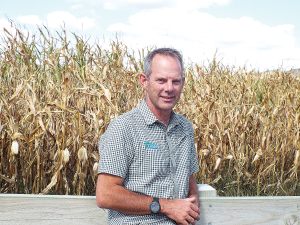
Surprised, humbled and quite thrilled. That’s the reaction of James Allen, one of the founding partners and now chief executive of AgFirst, on being made a life member of the Institute of Rural Professionals.
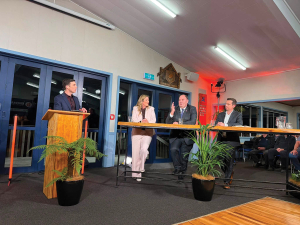
It was billed as a chance for all the political parties to woo the rural vote, but question marks hang over just how effective this was.
Minister of Conservation Hon Tama Potaka has appointed Susan O'Regan as Chair of the Queen Elizabeth II National Trust (QEII) for a three-year term.
Red meat farmers are welcoming Labour’s plan to review the Emissions Trading Scheme and not to campaign on pricing agricultural emissions.
Where any worker in the kiwifruit industry is mistreated, we expect the authorities to take action.
Mid Canterbury Federated Farmers arable chair, Bevan Lill, said Beef + Lamb NZ data indicated that for the last six years, the average arable return on investment was about 0.8% while inflation ran about 4% - so the average arable farm was going backwards at about 3% a year.