EU dairy co-ops to merge
Two European dairy co-operatives are set to merge and create a €14 billion business.
 increase font size
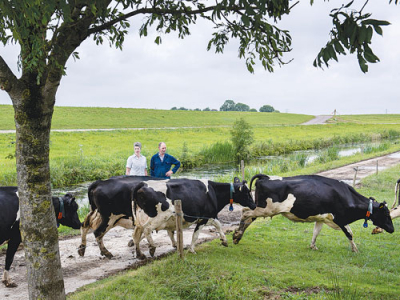 More Dutch farmers are grazing cows outdoors.
Dutch cooperative FrieslandCampina says more farmers are grazing their cows outdoors.
And it says the Dutch dairy sector has achieved its aim of 81.2% outdoor grazing two years earlier than agreed.
Despite an extremely dry summer, 303 co-op members started outdoor grazing last year, an achievement the dairy sector can be proud of, says FreislandCampina chairman Frans Keurentjes.
“As sector we can be proud that we again succeeded in growing the number of cows in the meadows and reaching our target of the sector for 2020.
“This all the more because the exceptionally hot and dry summer of 2018 greatly complicated outdoor grazing and grassland management.
“We succeeded in this thanks to the skills of the Dutch dairy farmer. Moreover, they are happy to contribute to the visibility of the cow in the Dutch landscape. The willingness of the consumer to pay extra for it gives an extra stimulus.”
FrieslandCampina encourages farmer shareholders to have their cows and young cattle graze in paddocks. Outdoor grazing is rewarded financially: farmers are paid $2.52 for 100kgMS from grazed cows.
To qualify, cows must graze in paddocks at least 120 days per year for a minimum of six hours per day.
Milk from grazed cows carries the co-op’s paddock milk logo.
FreislandCampina farmers are also involved in other sustainable dairying projects. Its PlanetProof programme involves dairy farms, farmers and dairy companies working together to improve nature, climate and animal welfare.
They use sustainable energy, emit less carbon dioxide and use less pesticide.
For cows, farms have massage brushes, sunbeds and outdoor grazing.
The high standards the farmers have to meet are regularly reviewed and, where necessary, made more stringent, FrieslandCampina says.
Co-op chief executive Hein Schumacher says it wants to be a frontrunner in sustainable dairy products.
“Together with our member dairy farmers, we have been working for years on a more sustainable dairy farm. Thanks to the ‘On the way to Planet Proof’ label, we show how we take the next step and continue to move forward.
“By buying dairy products with the ‘On the way to Planet Proof’ label, consumers can directly reward dairy farmers who are committed to animal welfare and improving nature and the environment. It is also an encouragement for other dairy farmers to make their farm more sustainable. That is good for the sector and for all of us.”
The first milk cartons with the ‘On the way to PlanetProof’ label went into Dutch stores last month.
The PlanetProof project is backed by the Dutch Ministry of Agriculture, Nature and Food Quality.
About FrieslandCampina
FrieslandCampina is among the world’s largest dairy companies with annual revenues of at least $20 billion.
It sells products in 100 countries, has branches in 34 countries and employs 23,675 people.
The co-op is owned by 18,645 member dairy farmers in the Netherlands, Germany and Belgium and is one of the world’s largest dairy cooperatives.
Two European dairy co-operatives are set to merge and create a €14 billion business.
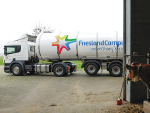
One of the world's largest dairy co-operatives is reporting a slump in half-year profits on the back of declining commodity prices and lower sales volumes.
Three major Dutch agribusinesses are joining forces to reduce nitrogen emissions at dairy farms.
European dairy co-operative FrieslandCampina is trialling a feed additive that is said to reduce methane emissions from cows by 30%.
One of the world's largest dairy co-operatives celebrated its 150th birthday this month.



Now in its fourth year, the 2026 Fencing Industry Awards, formed part of the proceedings of the FCANZ Conference, held in Nelson during August.
DairyNZ deputy chair Cameron Henderson has been re-appointed unopposed for another term.
OPINION: The stats speak for themselves.
Farms across the upper North Island are trialling different pasture mixes as part of a research programme that aims to build greater resilience into farming systems.
Election years are always a concerning time for farmers, according to DairyNZ chair Tracy Brown.
The Ballance Farm Environment Awards are coming to the West Coast of the South Island.