Massey Uses Portable Analyser to Measure Pasture Soil GHGs
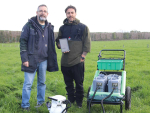
Researchers at Massey University are using a special piece of scientific equipment to improve the measurement of greenhouse gas emissions from pasture soils.
 increase font size
 Lisa Lyons
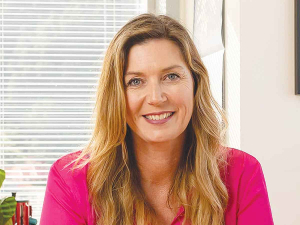
For Tararua District dairy farmer Lisa Lyons, ongoing professional development has always gone hand-in-hand with life on the farm, but a major health challenge prompted her to take her study journey even further.
Together with her husband, Lyons has spent over 20 years building a career in the dairy industry, working their way from farm management to farm ownership.
Since moving from Northland to the Tararua District in 2005, the couple have grown their farming business from sharemilking in Woodville to purchasing their first farm in Dannevirke in 2006, before moving to a larger farm in Pahiatua in 2015.
Now in her 30th season farming full-time, Lyons says the constant variety, challenge and opportunities to keep learning are what first drew her to the agricultural sector and what continue to motivate her today.
Her career has evolved significantly since graduating with a Bachelor of Applied Science in 1996, but after being diagnosed with osteoarthritis in her hip in 2023, Lyons realised it was time to expand both her study journey and future career opportunities.
“The diagnosis pushed me to complete my graduate diploma but also highlighted the need for a hip replacement. Although I kept farming, I realised my body was wearing out and I needed an exit plan if it resulted in an inability to continue working on the farm,” she says.
Returning to study after years in the workforce brought both confidence and uncertainty.
“I was, and still am, a little uncertain of my ability. But having life experience to draw on does help, though it can be harder to move away from established views and ways of thinking. It’s good to learn and grow, and I like to be challenged – this has certainly challenged me,” Lyons says.
She enrolled in the Integrated Farm and Environment Management course in 2025, where she found some aspects aligned naturally with her day-to-day farming experience, while others pushed her outside her comfort zone.
“I’m farming every day, so I had a good knowledge base, but the geology part was more difficult as I had less experience to draw on.”
Lyons says she found value in reconnecting with formal learning and engaging with both lecturers and fellow students. Now completing postgraduate study through a mix of on-campus and distance learning, she says the classroom environment remains her preferred way to learn.
“I enjoy being on the Manawatū campus as I find it easier to learn in a lecture classroom environment, alongside other students. Being able to discuss ideas and draw on other people’s knowledge really helps consolidate learning. However, studying via distance for the second semester is necessary, as even trying to find the time to sit down to get assignments done during calving is difficult!”
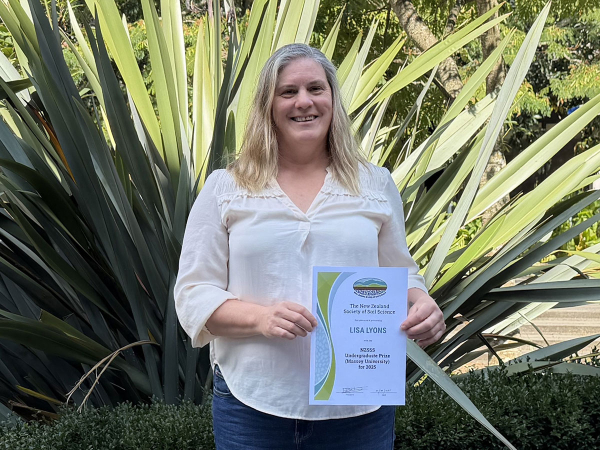
Her academic efforts were recently recognised with the New Zealand Society of Soil Science Undergraduate Prize, which recognises excellence in soil science research, technology and advocacy.
“It’s a real honour to receive, though I still find it difficult to accept that I deserve it!”
Lyons says her study experience has also reshaped the way she approaches farming and environmental management, particularly around freshwater farm planning and sustainability.
“It’s helped me better understand the complexity of farming systems and environmental policy. It’s taken away a lot of the unknown around freshwater farm plans and shown me how they can become an integrated and effective part of sustainable farming.”
Following the completion of her postgraduate certificate, Lyons is considering a master’s degree, though balancing it alongside farming remains a challenge.
“Apart from milking, there is no such thing as a typical day on the farm! For most of the season, it’s only me and my husband, though we employ an international student over the summer for a couple of months as part of their agricultural qualifications.”
This allows Lyons to tutor Primary Industry Training Organisation students completing their level three and four qualifications.
She and her husband
share the workload, but there’s always plenty to do – from calf rearing, feeding out and pasture management, to fencing, fertiliser spreading, compliance paperwork, financial planning, winter management, soil care and tending to the stock in their care.
The sheer variety of responsibilities is what Lyons says makes agriculture such a rewarding and versatile industry, with the range of skills developed on-farm coupled with education opening doors in countless directions.
“The opportunities for development and upskilling are limited only by imagination. Someone graduating with an agricultural degree could become a Member of Parliament, a company director, a dairy farm or herd owner, or a leader of a lobby group. It’s about forming a plan, working towards your goals, finding support and continuing to invest in education and personal development.”
Researchers at Massey University are using a special piece of scientific equipment to improve the measurement of greenhouse gas emissions from pasture soils.

Interest in agritech and production animal systems has prompted Massey University's School of Agriculture and the Environment to new majors to its popular animal science degree.
The industry is crying out for graduates with agricultural related degrees.
A four year trial has reaffirmed that mixing plantain into dairy pastures can help reduce nitrogen losses to freshwater while maintaining milk production and profitability, say researchers.
Special courses for secondary school teachers to help excite kids about agriculture and horticulture are now being run at Massey University.


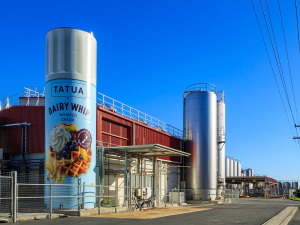
Waikato milk processor Tatua has again declared a record milk payout to farmer shareholders, leaving other processors in the dust.
A Labour-led Government won’t be bringing back the controversial freshwater rules of 2020.
National’s much-touted free trade deal with India featured in the Rural Issues Debate at Mystery Creek, Hamilton on Wednesday night.
New Zealand's 2026-27 freshwater fishing season has opened, with anglers encouraged to head to rivers and lakes over the coming days as conditions look favourable across much of the country.
Central Otago District Council (CODC) has voted against a plan to spread treated sewage sludge from Cromwell and Alexandra on farmland near Lauder, a decision Federated Farmers says reflects strong opposition from rural residents.
Pāmu has released its FY26 Integrated Annual Report, reporting a Net Operating Profit of $113 million, more than double the $49 million recorded in FY25.