Fall Armyworm in NZ Maize: Four Years of Research
Four years since it was first detected in New Zealand, researchers and growers now know much more about management of maize pest fall armyworm (FAW).
 increase font size
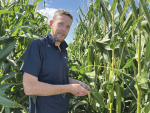
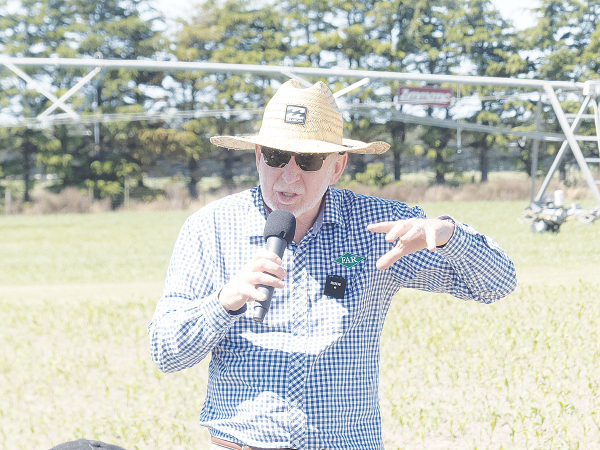 FAR's David Densley discusses his work into maize yields for South Island conditions, during the FAR CROPS 2022 event at Chertsey.
Climate change could make maize silage a more realistic fodder proposition for South Island dairy farmers, according to researchers speaking at the recent Foundation for Arable Research (FAR) CROPS 2022 event.
FAR senior researcher David Densley and researcher Owen Gibson spoke at the one-day event at FAR’s Chertsey research site near Ashburton, where a five-year maize project is in its second season.
They said Plant & Food Research climate modelling has shown that warming temperatures will allow maize to be grown in Southern areas which have previously been economically marginal, and may also bring larger, more frequent droughts in the North Island.
So, depending on future spring and summer rainfall patterns in the north, the South Island may become a major growing region for maize.
Maize silage demand from the dairy sector is increasing but economic yield and consistent forage quality are required for it to compete with imported palm kernel expeller (PKE) as a supplement for South Island dairy farmers.
Densley said that much of New Zealand’s maize agronomy is optimised for the major growing regions in the North Island but different management techniques may be needed in the South, where lower temperatures are a handicap.
He told the gathering that the trial was about finding the optimum plant spacing to allow the foliage to capture maximum sunlight, since sunlight that reached the ground was “wasted energy.”
“If we narrow up the rows then conceptually we intercept more sunlight. Makes sense.”
In much of the North American corn belt 76cm “seems to be the sweet spot” but the further north you go narrowing the rows to 50cm or even 38cm actually had about a 2% to 8% yield advantage, he said.
Newer genetics also tended to have narrower root architecture to take advantage of the narrower rows.
“Using the traditional row width and population density optimised for [traditional] growing regions may not maximise maize productivity and forage quality for South Island farmers,” said Densley.
Last season, an irrigated trial at Chertsey investigated Pioneer hybrid 8666 (CRM 86) planted on October 28, and harvested at 162 days. Row spacings were either 76cm or 38cm, and populations were between 95,000 and 120,000 plants/ha.
Owen Gibson explained that they had aimed for 100,000, 120,000 or 140,000 plants/ha but because the seed didn’t all strike to meet those targets, the trial didn’t produce results as significant as they hoped for.
Nevertheless, the narrow row spacing produced an average 2 tonnes of DM/ha improved yield – 30t DM from the 76cm rows and 32t DM from the 38cm rows.
A trial plot has again been planted this season to further investigate the interaction between row spacing and population, with rows at 30cm, 40cm, 50cm, and 70cm and populations of 90,000, 110,000 and 130,000 seeds/ha.
Densley said that especially in the south with its shorter growing season, it was important that maize had a starter fertiliser to provide young plants with nutrient as soon as the initial nutrients in the seed were used up.
Typically, starter fertiliser was placed 5cm away and 5cm below the seed but FAR was researching putting in liquid fertiliser even closer to the plant.
He said yield potential is set by V5.
“From V3 to V5, which happens very quickly especially on the warmer growing season, we’re setting yield, so you better hit the road running by then.”
Four years since it was first detected in New Zealand, researchers and growers now know much more about management of maize pest fall armyworm (FAW).
Two Canadian spraying experts, Tom Wolf and Jason Deveau, are visiting New Zealand in early August to ensure that arable growers are hitting the target with this key piece of equipment.
Tickets are now available for the 2026 Arable Awards, set to be held in Christchurch on 20th August.
As spring calving cows head into dry-off, the priority shifts to one thing: setting cows up to calve at the target body condition score (BCS).
Some of New Zealand’s best-loved food brands have been quick to sign up for a new campaign which reinforces their home-grown status.


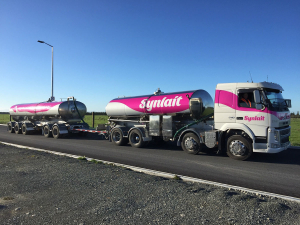
Synlait has swung to second-half profit as operations stabilise, but the dairy processor still posted a $75.4m annual loss.

LIC shareholders have elected a new North Island representative to the co-operative's Board, along with five representatives to its Shareholder Reference Group (SRG), following the company's Annual Meeting held in Invercargill.
Farmers across parts of Southland and South Otago are continuing to deal with difficult conditions after a prolonged run of wet weather, with pressure building around feed supply, stock management, pasture damage, farm infrastructure and everyday workloads.
Federated Farmers says it welcomes Labour's commitment to reviewing the Sharemilking Agreements Act, calling on other major parties to do the same.
For Canterbury dairy farmers Sian Meijer and Rick Wobben, wearable technology has become one of their most valuable on-farm tools - helping manage 1850 cows across an expansive, high-performing dairy operation while improving efficiency, mating outcomes and day-to-day decision making.
Fonterra has unveiled its annual results for the 2026 financial year, posting $27 billion in revenue and close to $20 billion returned to New Zealand farmer owners and unit holders.