Fonterra FY26 Results: $9.69 Milk Price, $3.4bn Profit
Fonterra has unveiled its annual results for the 2026 financial year, posting $27 billion in revenue and close to $20 billion returned to New Zealand farmer owners and unit holders.
 increase font size

FONTERRA HAS a serious problem but, contrary to the board’s claims, it is not redemption, says a Netherlands-based cooperatives expert.
“Share valuation is really the heart of the problem,” says Onno van Bekkum, chief executive of Coop Champions and a lecturer on cooperative businesses at Nyenrode Business University.
Van Bekkum has produced a report for a group of Fonterra shareholders concerned at TAF’s implications for the cooperative’s future, and supplied an exclusive preview article to Dairy News.
“There has been a lot of good thinking gone into this [TAF] proposal. But I fear with this impressive level of technical detail farmers might lose sight over the bigger picture,” he warns.
He doubts share trading will contribute to a stable cooperative, and says he can’t think of any example where such a system has worked to the satisfaction of farmers.
“I’ve just seen many cooperatives going down the drain when investor interests start prevailing over producer interests. That’s what TAF does: it deliberately creates a separate cluster of investor interests – both internal and external. You don’t want that in a cooperative. You want to keep a clear focus on producer interests.”
While he has concerns at what is effectively a scheme that will encourage some to cash in their shares, it would be understandable if it was a means to raise capital, he adds.
“Then at least you would build up something.”
As it is, the trading of dividend-bearing units linked to shares will simply drain up to 20% of dividends from the cooperative.
“If you decide to trade, why not start trading internally?”
He also doubts Fonterra will be able to limit the fund size, as it suggests.
“I don’t think farmers would vote in favour
of TAF thinking they won’t be using the fund. There will always be moments when people are in need of cash.”
He notes the blueprint itself mentions “avoiding a flood of shares into the fund after launch”.
“I fear it might not be long until the constitutional limit of 20% may be reached, with or without shocks created by droughts, diseases, financial crises, etc. And then what?”
The board has several options, as proposed in the risk management policy.
“Firstly, buying back units, which means you’re basically back on a track similar to redeeming shares. So how much do you gain from TAF?
“Secondly, introducing dividend reinvestment. Great, but you don’t need TAF for that!
“Thirdly, reducing the transfer limit, which requires members to buy back a portion of their shares: I’m not sure if that would really work in practice.
“Fourthly, issuing shares, to farmers presumably. Does that mean raising the limit on dry shares? Doesn’t that mean we’re further down the sliding slope then?
“Fifthly, altering the constitution to allow more than 20% in the fund. Is that what a ‘preferred option’ – to be recommended at a ‘special meeting’ for shareholders – could also be about? That, again, is risky.”
Van Bekkum says he would solve Fonterra’s valuation problem without introducing dry shares.
“The restricted share value was a step in the right direction.”
End-of-season transaction, a rolling three season-average production/share requirement, and three years to buy in/out all make sense, as does dividend reinvestment.
The fact that reducing share value to the restricted figure of $4.52/share from its $6.79 peak passed without uproar from farmers is a positive sign that shareholders, in general, are not overly focused on share value, he says.
“As the leadership has begun to see, the basis of any strong capital base is retained earnings. I think these are sufficient ingredients for a robust capital structure. I would be inclined to think you might not really need TAF.”
As for redemption risk, TAF effectively passes it to farmers.
“I think it’s not fair simply to pass that burden on to farmers’ shoulders. It’s not particularly cooperative. It’s amazing that farmers just accept that without discussion.”
Fonterra has unveiled its annual results for the 2026 financial year, posting $27 billion in revenue and close to $20 billion returned to New Zealand farmer owners and unit holders.
Fonterra Co-operative Group has confirmed the independently assessed candidates standing for election to its board in 2026.
Fonterra has revised its Farmgate Milk Price forecast for the 2026/27 season, lifting the midpoint and narrowing the range on the back of improving global dairy commodity prices.
Outgoing Fonterra Co-operative Council chair John Stevenson says that it has been a privilege to represent the co-op's farmer shareholders.
OPINION: It seems Canterbury processor Synlait is still in the doldrums.


Federated Farmers says it welcomes Labour's commitment to reviewing the Sharemilking Agreements Act, calling on other major parties to do the same.
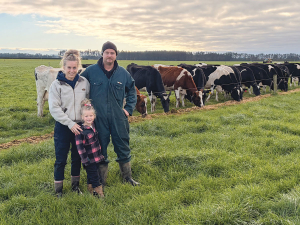
For Canterbury dairy farmers Sian Meijer and Rick Wobben, wearable technology has become one of their most valuable on-farm tools - helping manage 1850 cows across an expansive, high-performing dairy operation while improving efficiency, mating outcomes and day-to-day decision making.
Fonterra has unveiled its annual results for the 2026 financial year, posting $27 billion in revenue and close to $20 billion returned to New Zealand farmer owners and unit holders.
The first major update to the Dairy Cattle Code of Welfare in more than a decade has been released, marking what DairyNZ describes as an important step in ensuring animal welfare standards continue to evolve alongside scientific evidence and on-farm realities.
Ravensdown shareholders have elected Jane Montgomery and Kate Acland to the Ravensdown Board for three-year terms, following a closely contested director election.
Federated Farmers says new legislation replacing the Resource Management Act will cut red tape, unlock investment and help grow New Zealand's export-led economy, after the Planning Bill and Natural Environment Bill passed their third reading in Parliament yesterday.