Synlait FY26 Result: $75.4m Loss, Second-Half Profit
Synlait has swung to second-half profit as operations stabilise, but the dairy processor still posted a $75.4m annual loss.
 increase font size
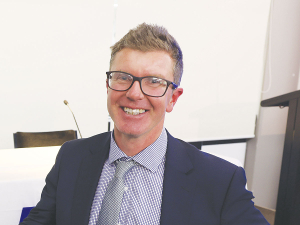
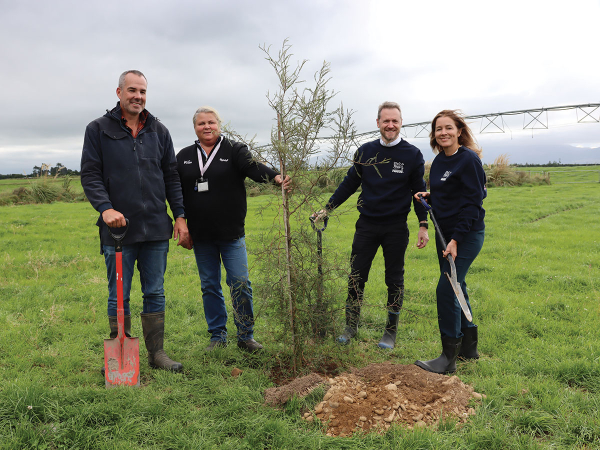 From left, Cam Henderson, Sarah Mason, Synlait, Eric Gorlier and Katja Seidenschnur, Nestle, plant a South Island Kōwhai, the first of 90,000 native trees
A partnership between Canterbury milk processor Synlait and the world's largest food producer, Nestlé, has been celebrated with a visit to a North Canterbury farm by a group including senior staff from Synlait, the Ravensdown subsidiary EcoPond, and Nestlé's Switzerland head office.
The viist to the Oxford farm of DairyNZ deputy chair, Cameron Henderson, included a ceremonial native tree planting, and a look at the EcoPond methane mitigation system in operation.
Aimed at reducing emissions and improving on-farm biodiversity, the Nestlé-Synlait partnership rewards farmers with a premium on their milksolids payout in return for their participation in one or more environmental initiatives.
Options include:
Synlait says nearly 40 Canterbury dairy farmers are participating in the scheme.
Chief revenue officer Hamish Yates couldn't tell Dairy News the size of the premium but said "it makes it worth their while".
Yates said the partnership's growth is a great example of how businesses can work together to make a real difference to the planet.
"Synlait has a history of pioneering sustainability. This partnership means we, and our farmers, will maintain our leadership position.
"It has been eye-opening to see the passion Nestlé, as one of the world's largest companies, has for helping New Zealand farmers reduce their emissions. It's a values-led approach that benefits everyone involved and the environment."
Yates said Nestlé was a significant customer and a large part of Synlait's ingredient business. Nestlé aimed to achieve net zero greenhouse gas (GHG) emissions by 2050 and dairy sourced from New Zealand was a critical part of that.
Nestlé global head of sustainability nutrition, Katja Seidenschnur, said that partnerships of this kind were instrumental for all parties to reach their emission targets.
"Dairy sits at the heart of Nestlé's business and at the heart of our climate challenge.
"Addressing emissions at scale requires partnership - across the value chain and on farm. That's why we're working closely with our dairy suppliers and farmers to turn ambition into action, through practical approaches to climate, methane and regenerative agriculture."
EcoPond Now A Mobile Service
The Synlait-Nestlé visit to Cameron Henderson's farm featured a look at the latest iteration of the Ravensdown and Lincoln University-developed EcoPond system in operation.
The system arose out of research by Professors Keith Cameron and Hong Di that showed that treating dairy shed effluent with a flocculent agent had multiple benefits including very effective suppression of methane and E.Coli, and altering phosphorus content to a more pasture-friendly form.
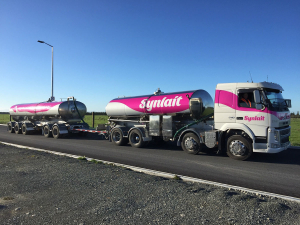
As development continued it was realised that there is no need for most farms to have their own infrastructure. EcoPond now takes the form of a truck-mounted plant that visits client farms and pumps effluent through the treatment machinery and back to the pond. The effects of each treatment last for at least several weeks.
Around 30 of the farms in the Synlait-Nestlé scheme have opted for EcoPond and are among the first farms to be treated in the country.
EcoPond Director Elliot Mercer said Synlait and Nestlé's support has been crucial to enabling the development and earlhy deployment of the technology.
"This backing helped move the latest version of EcoPond from a prototype into something that is now cutting methane emissions on New Zealand farms today. We are working toward EcoPond being formally recognised as an approved methane reducing tool by the government's Greenhouse Gas Inventory, which would be a significant milestone."
Mercer told Dairy News that the original EcoPond idea involved a significant and "economically challenging" capital investment on farm compared to the visiting service now being offered.
"We extract the effluent, it goes through the manifold where we treat it and it's closed, it's returned back into the pond and is mixed as it's going," he explained.
"That allows us to get suppression for over six weeks. Then basically we just come back on a periodic basis.
"So from a business model point of view, that means they're just paying for a service instead of actually having to build a lot of infrastructure and have all that complexity on farm."
Synlait has swung to second-half profit as operations stabilise, but the dairy processor still posted a $75.4m annual loss.
Speculation of a possible joint move by Fonterra and a2 Milk to buy Synlait raises a much bigger strategic question, says agribusiness expert Dr Nic Lees.
A revolving door of chief executives at milk processor Synlait is a warning sign, says Lincon University senior lecturer in agribusiness Nic Lees.
Troubled milk processor Synlait has lost its third chief executive in five years.


Synlait has swung to second-half profit as operations stabilise, but the dairy processor still posted a $75.4m annual loss.
LIC shareholders have elected a new North Island representative to the co-operative's Board, along with five representatives to its Shareholder Reference Group (SRG), following the company's Annual Meeting held in Invercargill.
Farmers across parts of Southland and South Otago are continuing to deal with difficult conditions after a prolonged run of wet weather, with pressure building around feed supply, stock management, pasture damage, farm infrastructure and everyday workloads.
Federated Farmers says it welcomes Labour's commitment to reviewing the Sharemilking Agreements Act, calling on other major parties to do the same.
For Canterbury dairy farmers Sian Meijer and Rick Wobben, wearable technology has become one of their most valuable on-farm tools - helping manage 1850 cows across an expansive, high-performing dairy operation while improving efficiency, mating outcomes and day-to-day decision making.
Fonterra has unveiled its annual results for the 2026 financial year, posting $27 billion in revenue and close to $20 billion returned to New Zealand farmer owners and unit holders.