Semi-robotic milking technology to boost parlour efficiency
Waikato Milking Systems’ latest innovation, ErgoPOD is now commercially available within New Zealand and Australia.
 increase font size
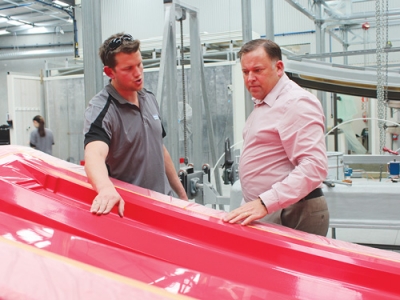 Waikato Milking Systems chief executive Dean Bell (right) and boatbuilder Josh Janmaat.
A challenge by a young Morrinsville boatbuilder to Kiwi milking systems makers in 2007 was picked up by just one – and the rest is history.
Waikato Milking Systems (WMS) took notice of boatbuilder Josh Janmaat's musings about milking platform deck sizes "getting up there" in weight.
Janmaat, whose father Peter is a dairy farmer, had discerned during a Fieldays visit in 2007 the huge wear and tear imposed by concrete rotary platforms on their support structures.
Janmaat mused that the decks "could be manufactured in fibreglass which includes Kevlar, as are aircraft and racing yachts. The result would be a deck much lighter and stronger than concrete. They'd be cheaper to run and would avoid a lot of damage to the 'I' beam."
Janmaat joined WMS and now leads a "small, talented team" producing what the firm's chief executive, Dean Bell, describes as the world's most technically advanced dairy platform.
The first Centrus composite platforms had 54 bails, then 60. In the last 12 months the company has launched the Centrus 84.
Bell, recently home from the World Dairy Expo in Wisconsin where the 84 bail Centrus was displayed, reports "tremendous interest" in the platform.
"The construction, so novel... attracts a lot of interest."
Janmaat explains: "The first stage of the platform is a wooden plug which becomes the template for the mould, then 400 hours of hand sanding and buffing is involved".
"The fibreglass/Kevalr sections of the platform are formed in closed moulds... enabling a better fibre-to-resin ratio." The process allows consistent quality, he says. Each section is identical, which is not possible using concrete or steel.
"The decks are bonded together by a high-strength adhesive also used to make aircraft and by NASA in the construction of space craft.
Accuracy during the manufacture and rolling of the platform beam is plus or minus 1.5 millimetres.
And where the beam meets the platform the pivot roller maintains perfect alignment with the rotary platform's support structure -- the 'I' beam. The resulting 100% contact enhances the platform's performance and decreases wear and tear.
Self-lubricating cast pivot rollers between two bearings are the only components that wear.
"Micro adjustment within the roller assembly provides precise height settings and allows a degree of fine tuning and precision never before achieved.
"This is especially important because cow loadings constantly change, especially at the beginning and end of milking.
"That uneven weight puts a point loading on rollers and bearings and can result in uneven wear which ultimately affects a platform's operation. The pivot roller overcomes that problem, making it relatively simple to maintain the platform's alignment."
The lower weight of the Centrus 84 is a big attraction for farmers, Bell says.
"The weight, with bail work, from the track up is around 12.6 tonne. Fully loaded with 84 x 1000kg cows (the design maximum weight), totals 92.6t.
A concrete equivalent weighs around 46.2t and, with 84 x 1000kg cows, equates to a total weight of 130.2t – a difference of 37.6t."
The 14 sections of a Centrus 84 platform fit into one shipping container.
"These decks are in demand worldwide by farmers operating intensive farming operations milking 24 hours a day, seven days a week.
"The Centrus 84 arrives on site anywhere in the world accompanied by a team from Waikato Milking Systems who oversee the unloading, setup and commissioning. Lasers are used to ensure the foundations and structure are true and precise."
Waikato Milking Systems’ latest innovation, ErgoPOD is now commercially available within New Zealand and Australia.
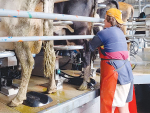
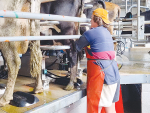
Waikato Milking Systems has unveiled the final production version of its ErgoPOD, a state-of-the-art semi-robotic technology designed to increase milking speed, productivity, and efficiency in the parlour.
While Waikato Milking Systems is committed to solving the challenges dairy farmers face with some of the world’s most innovative and technologically advanced dairy solutions, their approach differs from other companies, as their focus falls on retaining the essence of dairy farming.
Numedic Ltd has acquired a major part of Waikato Milking Systems' effluent and environmental business, including the well-known Cobra range of travelling rain gun irrigators.
OPINION: In the heartland of rural New Zealand, Waikato Milking Systems is on a transformative journey that seeks to revolutionise dairy farming practices with their latest innovation, ErgoPOD.


For Canterbury dairy farmers Sian Meijer and Rick Wobben, wearable technology has become one of their most valuable on-farm tools - helping manage 1850 cows across an expansive, high-performing dairy operation while improving efficiency, mating outcomes and day-to-day decision making.
Fonterra has unveiled its annual results for the 2026 financial year, posting $27 billion in revenue and close to $20 billion returned to New Zealand farmer owners and unit holders.
The first major update to the Dairy Cattle Code of Welfare in more than a decade has been released, marking what DairyNZ describes as an important step in ensuring animal welfare standards continue to evolve alongside scientific evidence and on-farm realities.
Ravensdown shareholders have elected Jane Montgomery and Kate Acland to the Ravensdown Board for three-year terms, following a closely contested director election.
Federated Farmers says new legislation replacing the Resource Management Act will cut red tape, unlock investment and help grow New Zealand's export-led economy, after the Planning Bill and Natural Environment Bill passed their third reading in Parliament yesterday.
Leading figures from the major political parties will be questioned on their primary sector policies at the Rural Issues Debate at Mystery Creek Events Centre, Hamilton, on 30 September.