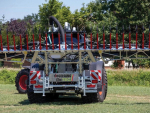
A eureka moment in a pub led a Midlands, UK contractor to capitalise on his council mowing contract by devising a novel way of turning the clippings into saleable livestock feed.
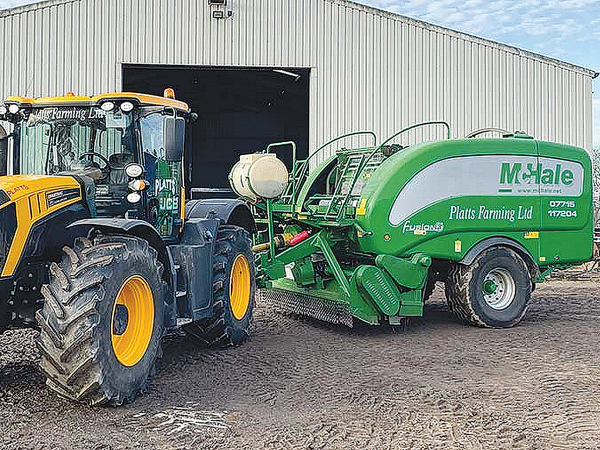
Mitch Platt’s plan involved a second hand McHale Fusion baler wrapper with the standard pick-up assembly removed and replaced with a flail mower, allowing him to cut, bale and wrap round bales in one pass.
Prior to the brainwave, Mitch’s work involved maintaining wildflower meadows or sites of scientific interest, with any clippings needing to be removed to prevent fertility build. This entailed cutting with flail mowers with collectors, transferring the debris to trailers with a grab loader then dumping on a muck heap. Although the system worked, it was labour intensive and decent grass was being dumped and left to rot.
As well as creating silage that could be sold or given to his own livestock, his idea offered a considerable time and labour saving over his original system.
The conversion was started in 2018, with the help of some employees and Mitch’s late father Roy, who was a skilled engineer. Roy’s experience was put to the test when it came to manufacturing pulleys for the driveline on a lathe and calculating rotational speeds.
He sourced a second hand, high bale count McHale Fusion 3 baler/wrapper from a dealer in Wales, its heavily worn pick up making it ideal for the project. The mowing element came by way of a 2.7m flail unit already on the farm, allowing a sub-3m transport width and the ability to deal with hidden, foreign objects.
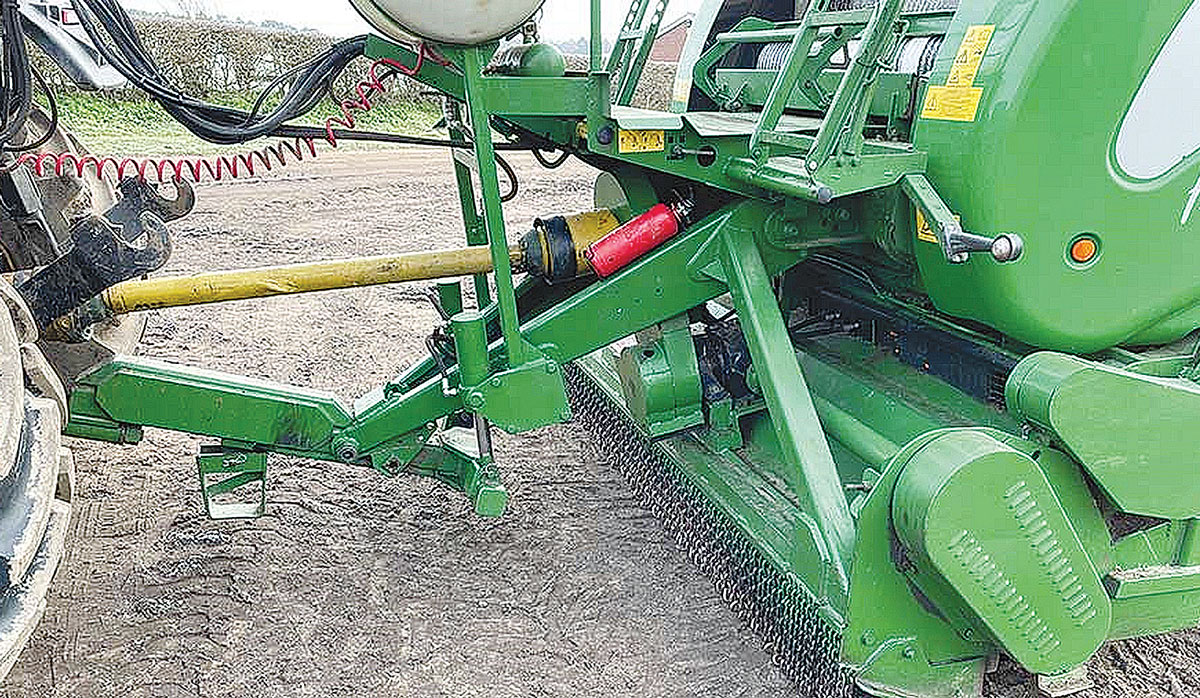
Much of the development centred on getting the mower positioned to throw grass into the baler rotor, and on a drawbar design that offered a way of adjusting cutting height. Other tweaks included widening the baler intake and extending the side feed augers to match the width of the mower.
 |
|---|
|
The Y-shaped flails on the mower cut the grass into 5cm lengths.
|
The driveline was sorted by Mitch’s father who cleverly designed a belt-driven system to accommodate the mismatch of the baler running at 540rpm and the mower at 1,000rpm, via a split format and a right-angled gearbox.
The final part of the system was to add a molasses tank, to make poorer grass more palatable, using air from the tractor to send a fine mist of molasses into the rotor via four jets.
Up and running for the 2018 season, bar a few minor teething problems, it worked well, although lack of visibility of the cut grass entering the baler means the driver needs to stay alert.
Working speeds range from 5km/h to 16km/h and cutting height is adjusted according to the conditions. The Y-shaped flails on the mower cut the grass into 5cm lengths, delivery bales that typically weigh around one tonne. Due to travel distances, a JCB Fastrac 4220 is the preferred power unit.