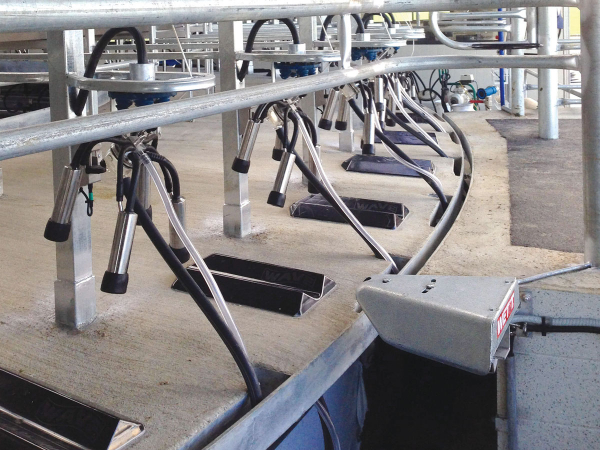
The teat cup liner is the only component of the milking machine that comes into contact with the cow's teat.
It has a large influence on milking performance, udder and teat health.
Benefits of the right selection and maintenance of teat cup liners included:
- Improved animal health - ensures teats are not damaged leading to issues with mastitis.
- Increased milking efficiency - the right liners will help to ensure clusters stay on and cows are not slow to milk.
- Reduced stress on animals - ensure the liners are not causing pain which will lead to cow discomfort and animal handling issues.
A good teat cup liner will:
- Provide an airtight seal at both ends of the shell.
- Provide a mouthpiece and barrel of a size that will fit a range of teat shapes and sizes, minimising liner slips and cluster falls and damage which can lead to mastitis.
- Milk out as quickly and completely as possible, minimising teat congestion, discomfort, and injury.
- Be easily cleaned.
Choosing the right liner
Choosing a liner is a compromise. One must consider the milking machine, its settings and very importantly, the cows.
Ultimately, if the proposed liner fits the milking equipment, it can be compared in the milking performance of your cows alongside other liners aiming for fast, efficient milking without any 'ill' effects.
Even then, a better performing liner may warrant some change in equipment.
The performance of cup liners is heavily influenced by the design and management of the whole dairy. Liner slip in particular is often not due to a problem with the liner itself. To optimise the milking process, milking machinery should be assessed in its entirety. Liners need to be carefully selected to suit the herd and machinery, and changed regularly.
Liners are commonly classified by their barrel size and shape, and by the material and/or method of their construction.
There are many liners available in New Zealand, the diameter of their mouthpiece lip ranges from 20-25mm, the mid-bore of the liner barrel from 20-28mm, and the effective length of the liner from about 120-170mm (depending on shell length).
The majority of liners available in New Zealand are made from Food Grade Synthetic rubber.
Maintaining Liners
A good cleaning system with regular hot alkaline washes is necessary to maintain liner performance. Poor cleaning can result in faster surface deterioration and bacterial growth.
Liners should be removed from jetter wash systems after cleaning. Leaving liners on any type of jetter between milkings will not allow the system to dry and can increase bacteria growth. Liners left hanging on button style jetters can distort the mouth-piece, increasing slip and reducing liner life.
Liners should not be re-tensioned by pulling them up to a second tension ring after half of their second life, they are worn out. Re-tensioning will only improve milking for a short time. Over-tensioned liners may lead to teat end damage.
Replacing Old Liners
Liners should be replaced as they are worn out, not retensioned. Re-tensioning will only improve milking for a short time and over-tensioned liners may lead to teat end damage.
The expectation that liners should last a full season does not take into account the growth in farm sizes in recent years. Liner life expectancy must be calculated for each individual farm based on herd size/number of clusters and milking frequency.
As a general rule of thumb, if you notice a distinct improvement in milking performance after replacing the old liners, you have probably used the old ones too long.
Old liners can also cause plant hygiene problems as the internal surfaces of older liners are more likely to become cracked and harbour bacteria.
With older liners there is also an increased risk of the liner splitting. If this occurs milk will be able to flow between milk side and air side of the milking machine, potentially resulting in milk quality downgrades.
Liners should be replaced after 2,500 cow milkings.
Article by DairyNZ