BCS Targets: Why Body Condition Score Matters at Calving
Body Condition Score (BCS) is a critical element in managing the health and reproduction of the dairy herd.
 increase font size
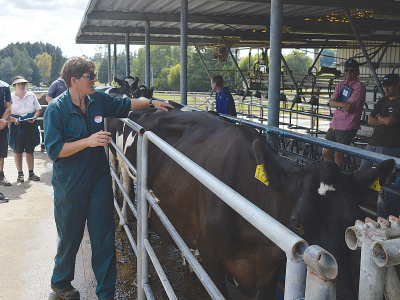 Vet Danielle Hawkins explains how to body score cows.
Getting an average body condition score (BCS) of 5.0 across a herd before mating isn’t all that useful, says vet Danielle Hawkins, Vetora.
She says farmers should aim for a “nice tight spread” of BCS in the herd.
Speaking at a Smaller Milk and Supply Herds (SMASH) field day at Te Awamutu this month, Hawkins said a good average BCS can still be a problem.
“Because you may have an average score of 5.0 [you may feel] like a hero, but if there’s a whole group of cows [about] BCS 3.0 it is still a disaster.
“What you want is a nice tight spread, and a better target is to have no more than 15% of the cows being too light. This would be better than that an average score of 5.0; on average that’s the middle cow score so you would have half the mob below the score and the other half above and it’s not all that flash.
“So, no more than 15% under BCS 5.0 is a better thing to work on.”
About 70 farmers turned up at the SMASH field day at the Rogers Charitable Trust Farm.
The 52ha-effective farm milks 190 cows and hopes to produce 74,000kgMS this season. MS/cow this season is expected to top 389kg. Feed includes silage, palm kernel expeller and some home-grown chicory.
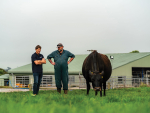
Farmers at the field day got a chance to assess the BCS of a group of cows from the herd. Hawkins told farmers they must look at the whole cow carefully to work out its BCS.
“Don’t just look at the ribs or the bums but scan the top of the cow and get a better average score,” she said.
She emphasised that the BCS among first or second calvers should be 5.5 as they are “low in the pecking order and most vulnerable”.
“Pretty much every dairy cow in this country will lose a condition score between calving and mating, no matter what you do,” she said.
“Even if you feed them more, you won’t stop that body condition score loss.”
What to look for
- Backbone: is it flat or is there a ridge? Can you see or easily feel notches?
- Long ribs: can you see or easily feel the ribs? If visible how many can you see?
- Short ribs: can you see the short ribs? What do they feel like? Are the rib ends sharp or rounded?
- Hip bones: are the hip bones rounded or angular?
- Rump: is the area between the pins and hip bones flat, sunken or hollow?
- Pin bones: are they pointed, ‘tap-like’ or rounded?
- Tailhead: is there a hollow between the tail head and pin bones? Is it a deep V or shallow U shape?
- Thigh: is the area indented, flat or rounded? Is the muscle structure defined?
Score 5.0 to 5.5
Calving cows and heifers with a body condition score (BCS) of 5.00 - 5.5 is important to optimise production and reproduction.
Animals calving with too high a BCS are prone to excessive loss of score after calving, with negative effects on health.
Conversely those too light are likely to have an extended non-cycling period and not achieve optimal production.
It is hard to measure the BCS of cows in the last month before calving, so animals should be set up in optimal BCS well before calving.
Most animals will lose some body condition after calving; the aim is to manage this loss to less than one unit.
Feed budgets should be set up and animals monitored regularly to ensure BCS losses are not excessive.
Excessive BCS loss results in mobilisation of excessive amounts of body fat, with potential negative effects on health and fertility.
Body Condition Score (BCS) is a critical element in managing the health and reproduction of the dairy herd.
The transition period is the make-or-break window for your entire season. If this period is poorly managed, you don't just see a few downer cows, you see a downward spiral that affects the cow's health, production and reproduction long into the season.
Body condition scoring ewes at least six weeks out from mating can make a significant difference to conception rates and scanning percentages.
The dry conditions being experienced along much of the east coast of both Islands build a strong case for body condition scoring ewes at this season’s weaning.
This is the third in a series of articles from Beef + Lamb New Zealand's Informing New Zealand Beef programme. The seven-year INZB partnership, supported by Beef+Lamb New Zealand and the Ministry for Primary Industries' Sustainable Food and Fibre Futures fund, aims to boost the sector's profits by $460m.



The Minister for Rural Communities, Mark Patterson, says there's a massive infrastructure deficit in rural areas.
New Zealand's red meat and fifth-quarter exports reached $867 million in August, up 23% on the same month last year, as stronger returns lifted earnings across all major markets.
State farmer Pāmu is bracing for a $30 million hit from soaring farm input costs this financial year.
Flat pricing in the face of significant increases in costs is the greatest problem facing the arable sector, says Foundation for Arable Research (FAR) chief executive Dr Scott Champion.
Entries opened on Monday, 5 October 2026 for the 2027 New Zealand Dairy Industry Awards (NZDIA), which organisers describe as the nation's biggest celebration of excellence in the dairy sector.
Waikato milk processor Tatua has again declared a record milk payout to farmer shareholders, leaving other processors in the dust.