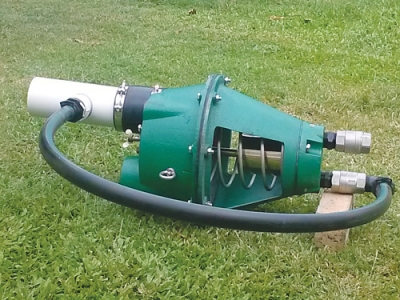
Glockemann Pumps provide an easy way of moving water where there is no power, or where the need for monitoring stationary engines is a headache, because they use the water itself to do the job.
With a design that only needs around a half metre of head, the pump is placed in a stream or river, and collects water through a drive tube and delivers it into the diaphragm chamber, and then exits via an exhaust valve. The water pressure against the valve slams it shut, allowing the water pressure in the diaphragm chamber to increase, which distends the diaphragm and moves the piston forward in the piston bore, which forces water through a non-return valve, and up the delivery pipe.
At the end of the push stroke, and when the energy is spent, pressure drops in the chamber, and the exhaust valve springs open, and a strong return spring pushes the diaphragm back to its original position. The piston returning in the bore draws in water via the lower non-return valve, and the cycle repeats itself.
Construction of the main housing is cast iron, with remaining components being stainless steel, and a diaphragm made from a piece of tractor inner tube type material. Dependent on the amount of head required to push the water to the storage tank a range of interchangeable piston tubes are available, with the narrowest delivering up to 200 metres head.
The product is low tech, has few moving parts, and especially has no metal to metal contact areas.
For more information visit the NZ distributor at www.eacs.co.nz