The recently released LIC statistics on how last spring’s mating went should be all the motivation you need to lift your submission rate and improve your 6 week in-calf rate (ICR).
Last year we saw a nationwide lift in average 3-week submission rates of 1%, up to 79%, and average 6 week ICR lifted to 66%, up 1% on the previous year.
That was the good news. The bad news is the not-in-calf rate fell by 0.5%.
Have you thought about what you can do to improve on last year? As a quick refresher, the mating targets you should be aiming for are:
- Pre-mating heats of >85%
- 3-week submission rate of 90%
- 3-week in-calf rate of >60%
- 6-week in-calf rate of 78%
- 12-week empty rate of <6%
These targets may seem high to some, but they are achievable and some farms are even surpassing them.
Hopefully, you have a written mating action plan of what happens on what dates. It is not surprising to find that farmers who have a detailed and dated mating plan achieve better mating performance than those who don’t.
It is vital to involve all staff in this process.
Have look at your Fertility Focus Report in Minda to see the main areas you need to improve in.
Have you decided on how you will deal with non-cycling cows (cows without a heat >30 days post-calving)? Use of OAD, bulls and hormone intervention are options, but do you know what works best for your farm? Have you measured and reviewed results from intervention in past years?
Heat detection has to be the top priority and time allocation each day at this time of year. On a $6 pay-out, each missed heat is worth $190 per cow (excluding the value of more heifer calves).
This has been an area of steady decline in NZ herds, partly due to less human contact time with cows as herds and farms have got bigger, and more specialisation of staff to specific jobs.
This all means that good systems and staff training are vitally important.
The more time spent observing cows in the paddock, the higher your submission rate will be and the higher the chance of a better 6-week in-calf rate. To maximise your submission rates consider the following:
Do not just rely on reading tail paint or detection aids in the cowshed.
Observe cows as quietly and naturally as possible.
Draft any of these suspect cows out prior to the AB technician arriving into the cycling group, and observe behaviour of these uncertain cows. Will they stand to be ridden or not?
Return mated cows to the herd after insemination to help identify the next day’s cycling cows. This becomes very important in the second round of AB in smaller herds.
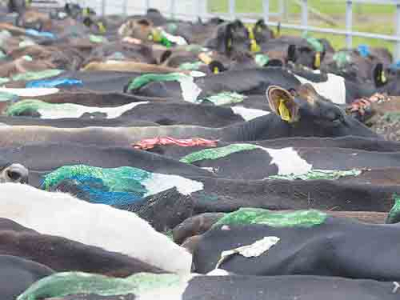
Tail paint the mated cows again the following milking with a different colour.
Minimise the number of people responsible for heat detection, as this minimises excuses and mistakes.
To identify those quiet and short heats, spend 20 minutes 2-3 times a day in the paddock at the following times:
Two hours after cows have had a new break of grass, as activity is often highest then, and
When getting cows out of the paddock before milking.
Bull management
If you are using natural mating bulls, take extra care to ensure you source bulls from a farm that fits within your farm’s biosecurity criteria and you have reviewed the details of their movement history.
All bulls must be BVD tested and vaccinated.
Yearlings are best with 1 bull per 20 yearlings. The main herd will require enough bulls to cover no more than 1.5 cows to service per day (30:1 ratio). You will also need bulls to provide rest and rotation so they don’t become tired or lame. Every farm differs in required level of cover, but two teams of bulls rotated every 24-48 hours works well.
Will your farm be one of the farms that identifies its weakest link in the big repro puzzle and tackles it head on this season? Your move.
Staff training
Sometimes we assume everyone is on the same page as us and can pick bulling cows. If you have new staff, take them to a training day and go through the farm mating plan.
Ensure everyone knows how to pick bulling cows and understands the farm’s systems for recording heats, submitting cows for AB and re-tail-painting cows.
If you have experienced staff, the time taken to refresh people on what everyone needs to be doing through mating will undoubtedly pay off.
Setting targets and goals with the team over breakfast with a stated reward of attaining realistic but stretch targets in 6 week ICR and empty rates could be what your team needs.
Two hours allocated here could pay thousands of dollars in returns.
• Darren Sutton is FarmWise consultant