
NZKGI Responds to Migrant Worker Exploitation Reports
Where any worker in the kiwifruit industry is mistreated, we expect the authorities to take action.




 increase font size
 Immigration Minister Erica Stanford says RSE changes will be implemented over two years.
There's strong support from the horticulture sector for the Government's plans to overhaul and streamline the Recognised Seasonal Employer (RSE) scheme.
The scheme allows orchardists and growers to bring workers from the Pacific Islands to work on their properties for a limited period each year.
Immigration Minister Erica Stanford announced this at the HortNZ conference last week, saying that over the 20 years the scheme has been running, it has become more complicated and burdensome than it needs to be.
She says the changes that will be implemented over the next two years will provide greater clarity and flexibility to both employers and workers. It will also strengthen protection for workers.
"This move is in response to sector which for a long time has been calling for change," she says.
All told, 17,000 RSE workers come to NZ each year working for more than 200 recognised employers.
In essence, the revamped RSE scheme will reward employers with good track records and put the heat on those who haven't lived up to the spirit of the scheme.
"Bad actors will face consequences," she says.
Stanford says the one-size-fits-all approach when employers are applying to recruit workers is no longer appropriate and, in this regard, established employers with a strong track record will be given special consideration and pathways.
Other key changes include introducing a fixed list of exactly what costs employers can pass on to workers - an area where there has been a lack of clarity, confusion, and angst in the past. The intention is that workers should be aware of this before they arrive in NZ.
There will also be a provision that allows workers the flexibility to do other tasks on a property outside the normal planting, maintaining, harvesting and packing of produce. Under this provision they may be able to, say, drive a forklift. Workers may also be able to work for another accredited RSE employer if work runs out on their property and is available elsewhere.
Stanford says accommodation standards are a major concern and remain a priority for both industry and Pacific partners.
"We need to get this right," she says.
Stanford says consultation on options for change is currently underway with Pacific partners and employers, and she expects to take decisions by the end of September.
"We are also supporting industry-led initiatives that promote best-practice pastoral care. Providing access to the internet will also be added to the prescribed standards, ensuring workers can stay connected with their families back home. There will also be new provisions for sick leave," she says.
Stanford says the changes recognise the important role the RSE scheme plays in assisting the NZ hort sector. The changes will be phased in over the next two years.
HortNZ chief executive Kate Scott says her organisation is hugely grateful for the changes.
She says the decision to modernise the RSE scheme is a positive and practical step that will benefit growers, workers and Pacific communities.
"From our perspective the changes are sensible and will enable the scheme to operate more effectively and efficiently," she told Rural News.
"Little things like aligning sick leave right through to enabling RSE workers to also do some of those other tasks that sometime arise on the orchard like driving the forklift are important," she says.
Scott says the changes will reduce unnecessary compliance for trusted employers.
A graduated accreditation model, clearer expectations and a more transparent cap process will give growers greater certainty to plan, invest and grow. She says the changes will also put worker wellbeing at the centre of the scheme's future.
"HortNZ has consistently called for settings that are fair, future-proofed and sustainable for employers and workers. This reform reflects that approach," she says.
Colin Bond, the CEO of NZKGI, which represents kiwifruit growers, says his organisation is pleased with the announcement.
He says anything that simplifies something that has become a complex scheme will be well received by the industry and getting clarity around what costs can be passed onto workers and moves to improve accommodation for RSE workers is good news and beneficial to all parties.
"This is a fantastic scheme that's been running for twenty years. But over time we have been adding more things to it to make the scheme better, however, we seem to have inadvertently made it more complex," he says.
Bond says NZKGI appreciates the hard work that MBIE staff, the Pacific people and many others have put into creating the new reforms.
He says it is important that through the implementation stage everyone works together to achieve the desired outcomes.
Where any worker in the kiwifruit industry is mistreated, we expect the authorities to take action.

Kiwifruit growers are watchful but remain optimistic as concerns around the potential effects of the El Niño weather pattern this season.
James Blair, an agronomist for AS Wilcox and the Pukekohe regional champion, has won the 2026 Young Grower national title.
Claimed to be the first autonomous robot for New Zealand vegetables growers, the first Kilter AX-1 unit has arrived in the country.
After delivering a strong financial year, rural trader PGG Wrightson says the coming months will depend on customer confidence and weather.


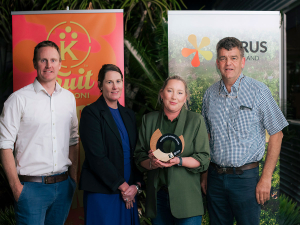
New Zealand's citrus growers were challenged to build their future on the value embedded in their fruit rather than the volume they produce, at Citrus New Zealand's annual gathering in Gisborne on 17 September.

Leading John Deere technicians and apprentices from New Zealand and Australians were recognised at the recent sixth annual JD Technician of the Year Awards, held in Brisbane.
In Dacre, near Invercargill in New Zealand’s South Island, Bruce Dinnington is running a dairy operation unlike any other.
A free online platform aggregating governance vacancies across rural and regional New Zealand has been launched.
Environment Minister Nicola Grigg has announced details of a new rural plastics recycling scheme.
Agricultural drone operators say that a government decision to allow lower-risk drone work without certification won’t lower standards but drive innovation and efficiency.




OPINION: The same mainstream media muppets that brought you Jacindamania in 2017 have been flat out pimping for the Opportunities…
OPINION: Your old mate reckons the atrocious way farmers in the UK are treated by their lords and masters in…




