Fonterra FY26 Results: $9.69 Milk Price, $3.4bn Profit
Fonterra has unveiled its annual results for the 2026 financial year, posting $27 billion in revenue and close to $20 billion returned to New Zealand farmer owners and unit holders.
 increase font size
Dairy farmers will be bracing for sombre news from Fonterra this Wednesday.
Six months ago, the 2015-16 season prospects were looking bright. Falling dairy prices were tipped to rebound within six months; sadly, that prediction hasn’t come to pass.
With five consecutive drops in the Global Dairy Trade price index, any hope of a price bounce-back this year has all but evaporated.
It’s hard to believe that Fonterra announced an opening forecast of $7/kgMS for the 2014-15 season a year ago; after several revisions, the forecast payout for the season stands at $4.50/kgMS milk price and 20-30c/share dividend.
The year before, it first forecast was $7 but paid farmers a record $8.40/kgMS! So all is not lost. Dairy prices could rebound. But for that to happen, all the ‘planets’ have to align: Russia’s trade ban on European dairy products must go, China has to resume buying and oil prices must rebound to give Middle East consumers more disposable income to spend on dairy products. Throw in also some unknowns: the path of the US currency and milk production in the quota-free European Union.
What Fonterra will announce this week is difficult to predict, since it will base its opening forecast on events in the coming 15 months. As one anaylyst says, if current prices were to persist for the next 15 months, the payout could be even lower than this season.
But if your forecast was for an improvement in international prices over the next 15 months and a lower Kiwi dollar, then farmers would be looking for something higher than $5/kgMS.
Whatever Fonterra opens with this week, farmers must brace for another tough season. Discretionary spending must be curtailed and farm management practices maintained.
But then farmers deal with change all the time, ever mindful of sunshine, rain and a host of things governing a livelihood that wholly depends, ultimately, on the natural elements. This is part of the volatile world they deal with. Now, throw in commodity prices and exchange rates and you have an extremely challenging environment. This is an accepted fact of life for a farmer.
Given dairy’s importance to New Zealand, our leaders are sitting up and taking notice. Problems facing the dairy industry are now in the headlights of the governor of the Reserve Bank, Graeme Wheeler.
All eyes are on the dairy industry; this week Fonterra will give its take on what is likely to happen over the next 12-15 months, and we will hope, as we must, that a splendid planetary alignment will soon cause a lift in the prices.
Fonterra has unveiled its annual results for the 2026 financial year, posting $27 billion in revenue and close to $20 billion returned to New Zealand farmer owners and unit holders.
Fonterra Co-operative Group has confirmed the independently assessed candidates standing for election to its board in 2026.
Fonterra has revised its Farmgate Milk Price forecast for the 2026/27 season, lifting the midpoint and narrowing the range on the back of improving global dairy commodity prices.
Outgoing Fonterra Co-operative Council chair John Stevenson says that it has been a privilege to represent the co-op's farmer shareholders.


Federated Farmers says it welcomes Labour's commitment to reviewing the Sharemilking Agreements Act, calling on other major parties to do the same.
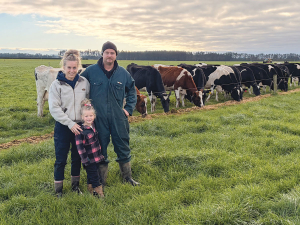
For Canterbury dairy farmers Sian Meijer and Rick Wobben, wearable technology has become one of their most valuable on-farm tools - helping manage 1850 cows across an expansive, high-performing dairy operation while improving efficiency, mating outcomes and day-to-day decision making.
Fonterra has unveiled its annual results for the 2026 financial year, posting $27 billion in revenue and close to $20 billion returned to New Zealand farmer owners and unit holders.
The first major update to the Dairy Cattle Code of Welfare in more than a decade has been released, marking what DairyNZ describes as an important step in ensuring animal welfare standards continue to evolve alongside scientific evidence and on-farm realities.
Ravensdown shareholders have elected Jane Montgomery and Kate Acland to the Ravensdown Board for three-year terms, following a closely contested director election.
Federated Farmers says new legislation replacing the Resource Management Act will cut red tape, unlock investment and help grow New Zealand's export-led economy, after the Planning Bill and Natural Environment Bill passed their third reading in Parliament yesterday.