Fonterra Elections 2026: Voting Opens Tuesday 20 October
Fonterra shareholders can begin voting on Tuesday 20 October in the 2026 Board of Directors’ election, a Co-operative Council election in one Ward, and seven Annual Meeting resolutions.
 increase font size
 Professor of Agricultural Economics, Alan Renwick.
The Irish dairy industry is keeping a close eye on New Zealand's dairy dilemmas as it ramps up its own production with quota restrictions now gone, a Lincoln expert says.
Professor of Agricultural Economics, Alan Renwick, recently joined Lincoln from University College Dublin (UCD) in Ireland.
He says high debt levels, Fonterra's challenges, and the movement away from grass-fed production methods here, are capturing Irish attention.
With quotas now removed in Europe, by the end of 2014 $4.53b had been invested in new production facilities for dried dairy products in Europe, mainly in Ireland, North West France, Netherlands, and Denmark.
Professor Renwick says leading up to the removal of quotas, much in Ireland was made of the fact that in 1984, when they were implemented, Ireland and New Zealand produced roughly similar quantities of milk, and production had been growing at a significant rate.
Due to quotas, Ireland remained at that level, around 6 billion litres for nearly 30 years, while production in New Zealand increased fourfold, so Irish eyes have been turned south to see how.
However, everything is not seen as positive.
The high levels of debt in New Zealand are used as a warning to the Irish industry as it develops post quota, he says.
"A strength in Ireland is the low indebtedness of Irish farms. There is concern that expansion will lead to increases in debt and the vulnerability of businesses."
Ireland also has a much more fragmented processing sector than New Zealand and much had been made of the Fonterra model and that Ireland should try and emulate this, he adds.
"However, recognition of the challenges facing Fonterra, and the success due to innovation of some of the Irish cooperative businesses, have raised questions in the minds of those in the sector whether actually smaller more flexible businesses may not be so bad after all."
Like New Zealand, much is also made in Ireland of sticking with the grass based seasonal system aimed at keeping forage costs at a minimum.
However, commentators feel New Zealand is moving too far from its core strength, grass production, and therefore in danger of losing its competitive advantage.
He says Bord Bia (the Irish Food Board) have invested heavily in developing and promoting their sustainability programme, Origin Green.
"This is which particularly relevant to the recent events in New Zealand as it has a strong focus on Animal Health and Welfare."
Asia is also increasingly becoming the market of choice.
"With EU markets stagnant, or declining, much of the new production from Ireland is targeted at the same markets as New Zealand's production.
"Origin Green ambassadors, working with Irish companies, are being placed in markets across the globe to develop the sustainability message."
Increasingly, he says, they are also investing heavily in trying to improve understanding of the needs of Asian customers, and are supported by recognition in Asia of the strength of EU Food Safety legislation and practices.
Fonterra shareholders can begin voting on Tuesday 20 October in the 2026 Board of Directors’ election, a Co-operative Council election in one Ward, and seven Annual Meeting resolutions.

Fonterra Co-operative Group chief financial officer Andrew Murray has resigned to take up a role outside the dairy giant.
Four candidates have been confirmed for two director positions on Fonterra’s board.
A record farmgate milk price and strong global demand is laying the foundation for continued growth of organic dairy farming in New Zealand.
Waikato milk processor Tatua has again declared a record milk payout to farmer shareholders, leaving other processors in the dust.


Mark Hooper has been appointed the new chair of NZPork, the industry organisation representing New Zealand pig farmers.
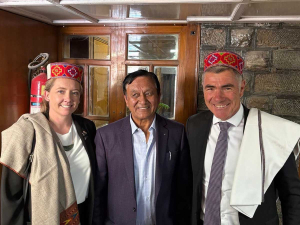
As the India-New Zealand free trade agreement enters into force, New Zealand’s apple industry has reaffirmed its commitment to the long-term development of India’s apple sector.
Fonterra shareholders can begin voting on Tuesday 20 October in the 2026 Board of Directors’ election, a Co-operative Council election in one Ward, and seven Annual Meeting resolutions.
National’s pledge to introduce 19 new national standards shows the party is serious about getting Wellington out of farming, Federated Farmers says.
The National Party’s policies to make it easier to grow fresh vegetables, secure reliable water and energy and simplify farm planning are practical changes that will give growers the confidence to invest, according to Horticulture New Zealand (HortNZ).
Fonterra Co-operative Group chief financial officer Andrew Murray has resigned to take up a role outside the dairy giant.