Fonterra CFO Andrew Murray Resigns
Fonterra Co-operative Group chief financial officer Andrew Murray has resigned to take up a role outside the dairy giant.
 increase font size
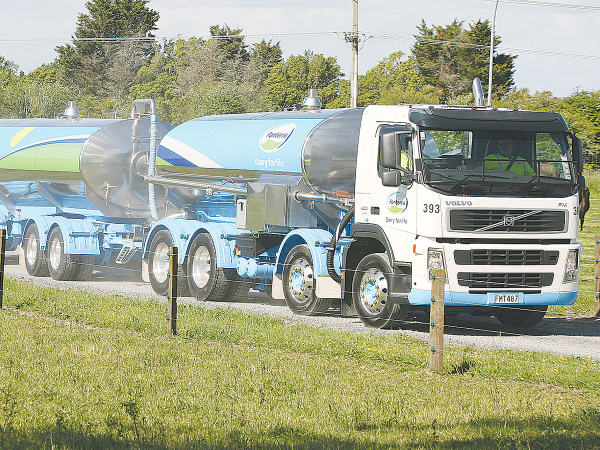 The forecast Farmgate Milk Price has lifted recently, with a current midpoint of $7.80/kgMS.
Fonterra says that while global inflationary pressures are easing, it is monitoring the potential for volatility because of geopolitical instability.
Announcing its half-year results this morning, the co-operative is prepared for any logistical disruption.
“Our partnership with Kotahi and diversification across markets means we’re well prepared for disruption in global supply chains or changes in demand from key importing regions,” says chief executive Miles Hurrell.
“We’re pleased with our first half performance for FY24 and look forward to the second half as we continue to deliver for our farmer shareholders and unit holders,” says Hurrell.
Hurrell says the co-op’s performance has been driven by higher margins and sales volumes across Fonterra’s diversified product and category mix.
“I’m pleased to report we’ve continued the positive momentum seen in our earnings performance and delivered an interim dividend of 15 cents for our co-op’s farmer shareholders and unit holders, up from 10 cents this time last year.
“The forecast Farmgate Milk Price has also lifted recently, with a current midpoint of $7.80/kgMS, following volatility earlier in the season.
“While supply and demand dynamics remain finely balanced, with continuing global uncertainty, we are now well progressed through the season. This gives us the confidence to narrow our forecast Farmgate Milk Price range to $7.50 - $8.10/kgMS.”
For six months ending January 31, Fonterra’s profit after tax rose 23% compared to last year to $674 million. Return on capital rose 13.4%, up from 8.6%.
Hurrell also gave an update on the co-op’s new strategy.
He says it has continued to make progress on its strategy with new initiatives in place to create value for farmers, commercialise sustainability position and unlock capacity through innovation.
“Our new capital structure has been in place for a year and encouragingly, we’re seeing new co-op farmers citing it as a reason for returning to the Co-op. Some are wanting to take advantage of the flexible shareholding options now available to them and this, coupled with the co-op’s stability, means we have a strong pipeline of farmers wanting to join the co-op.
“We have also been utilising our scale, optionality, and strong balance sheet to deliver benefits to farmers. This includes getting cash to farmers sooner through our revised Advance Rate guideline.”
Earlier this financial year, Fonterra returned $800 million to farmer shareholders and unit holders following the divestment of Soprole. It also completed the sale of DPA Brazil JV with Nestlé to Lactalis.
“Since announcing our on-farm emissions target, we have been working with customers to commercialise our farmers’ sustainability credentials. This includes introducing to customers our regenerative agriculture position, which recognises our farmers’ pastural farming system.
“We’ve continued to decarbonise our New Zealand operations as we progress toward the co-op’s scope 1 and 2 emissions reductions target, including commissioning our wood biomass boiler at Waitoa and announcing plans to electrify our Edendale site.
“We’ve also deployed a new technology within our manufacturing base which has unlocked 8000 MT additional production capacity for our high-value UHT cream,” says Hurrell.
Fonterra Co-operative Group chief financial officer Andrew Murray has resigned to take up a role outside the dairy giant.

Four candidates have been confirmed for two director positions on Fonterra’s board.
A record farmgate milk price and strong global demand is laying the foundation for continued growth of organic dairy farming in New Zealand.
Waikato milk processor Tatua has again declared a record milk payout to farmer shareholders, leaving other processors in the dust.
Fonterra has unveiled its annual results for the 2026 financial year, posting $27 billion in revenue and close to $20 billion returned to New Zealand farmer owners and unit holders.



Fonterra Co-operative Group chief financial officer Andrew Murray has resigned to take up a role outside the dairy giant.
A major move is about to get underway to improve the quality and viability of dairy beef and cattle in NZ.
Veterinarians say changes to the code of welfare for dairy cattle provides a positive foundation for improved cattle welfare across the country.
Today, 15 October, is the International Day of Rural Women, which recognises rural women’s contribution to farming, communities and the environment.
Global dairy giant Lactalis has integrated its Australian operations with the Mainland Dairy consumer business it acquired from Fonterra earlier this year.
High country stations, mixed sheep and beef farms, Māori-owned farms, corporates and family operations are among the nine commercial farms taking part in the Livestock Innovation Farming Transformation programme, known as LIFT.