
Red Meat Sector Experiences Record Returns in 2025/26 Season
The red meat sector finds itself in "a very rare set of circumstances", says Federated Farmers meat and wool industry chair Richard Dawkins.
 increase font size
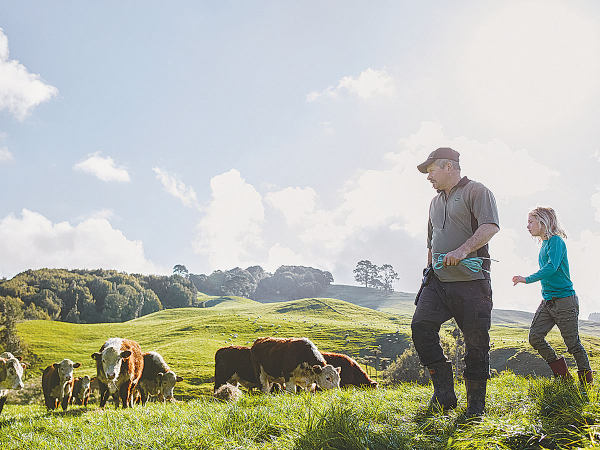 The latest BNZ Rural Wrap reports that many primary product prices are above their five-year average. Photo Credit: Paul Sutherland Photography
While the majority of primary sector prices are generally strong, there are also several challenges ahead for the sector, according to the latest BNZ Rural Wrap report.
"For many major product categories, prices are above their five-year average, and some materially so," says BNZ senior economist Doug Steel. "These outcomes are mostly the result of buoyant prices in offshore markets." However, the report also concedes that all manner of disruptions across international supply chains has seen supply struggle to satisfy robust demand. It also adds that a subdued NZ dollar - relative to buoyant offshore prices - has supported primary product prices in New Zealand dollar terms.
"The NZ/US dollar exchange rate has lifted from pandemic lows under US $0.60 last year, but it has failed to kick on even as primary prices offshore have risen over the past year," Steel says.
"The last time world prices for NZ's major primary export products were around current levels was in 2014. Back then, the NZ/US exchange rate was well over US$0.80. Firm world prices and a subdued NZ dollar is a positive mix for NZ primary producers."
Steel believes factors keeping the NZ dollar lower include, in the bank's view, the ongoing overvaluation of the US dollar, lower domestic interest rates relative to those offshore, as well as the loss of net tourism and education foreign exchange earnings, and rising costs.
However, he warns that rising costs are risk.
"Official figures show average costs in Q2 accelerating in the primary sector, up 3.4% on average over the year. Of couse, some individual costs have lifted significantly more than that."
Steel aslo points to growing inflation as a potential challenge for the sector and the NZ economy as a whole.
"Material increases in both export and import prices reflects the generally more inflationary environment that is percolating at present - the strongest we have seen for quite some time," he explains. "Rising costs are a reason to not overly celebrate the generally positive selling prices NZ is experiencing. It is margins that matter more."
Steel adds that costs escalation appear to have continued into the second half of 2021.
"Take fertiliser prices, for example. Offshore prices for the likes of urea and DAP have more than doubled since the pandemic started and have continued to rise over recent months," he says. "This has put upward pressure on domestic prices, given the limited offset from movements in the NZ dollar."
The report highlights the lift in oil prices - at around double what it was a year ago,
"Again, with muted movement in the NZ dollar this has translated into higher fuel costs around the country including for the primary sector."
Meanwhile, Steel says it is not just the cost of products that is on the rise, but also the costs of moving it.
"International freight costs continue to ramp higher. Recent figures show that international freight costs for NZ rose 20% in Q2 alone, adding to the 52% hike in Q1. These costs are up a whopping 112% on a year ago."
He adds that it is not just freight costs that are troublesome, with logistics like shipping delays and container issues adding to the challenges.
"Disconcertingly, offshore freight cost indicators show no sign of relief on this front," Steel explains. "Many expect global shipping congestion issues to extend well into next year, which would only add complexity to logistics through the main primary selling season."
Meanwhile, he says the labour market remains a chronic supply choke point.
"Primary producers are in the thick of this. A recent Federated Farmers survey showed a net 49% of farmers reported difficulty finding staff. That is as high as it has been since the survey started more than 10 years ago."
Steel says more RSE workers will help, but only at the margin. However, he believes the recently announced one-off resident visas that creates a residence pathway for about 165,000 in situ migrant workers and their families (about 9,000 primary sector workers) will be welcomed across the industry.
"It will provide much needed certainty and support retention of employees. But we anticipate tight labour market conditions to continue."
The report concludes that given all of these factors, it is no surprise to see farmers expecting cost increases ahead.
The red meat sector finds itself in "a very rare set of circumstances", says Federated Farmers meat and wool industry chair Richard Dawkins.
A solid recovery of global dairy prices this year makes a $9.50/kgMS milk price almost a shoo-in for this season.
The chance of a $10-plus milk price for this season appears to be depleting.
A stronger than expected outlook for dairy has prompted one bank to lift its 2025-26 season forecast milk price by 75c to $10.25/kgMS.
Following several years of pain, farmers and growers are facing a decent upswing in commodity prices, say economists.



For Taupiri dairy farmers Logan and Sian Dawson, their involvement in the NZ Dairy Industry Awards has been a key catalyst in the growth of their business - the experience helping shape how they approach the farm ownership pathway they are pursuing today.
West Otago dairy farmer Luke Kane has been awarded the 2026 Rabobank Dr John Morris Business Development Prize.
OPINION: As the general election approaches, political parties are churning out policies in the hope of attracting more votes.
An LIC bull, Tronnoco AR Sadio-ET S3F, bred by Tony and Keri O'Connor of Tronnoco Farming Co Ltd near Timaru, has won the 2026 Mahoe Trophy.
With forecasters advising El Niño conditions will develop through winter and strengthen into spring and summer, Ballance Agri-Nutrients is encouraging farmers and growers to think ahead about nutrient planning and be prepared to work around challenging weather conditions.
A Palmerston North shearer has been sentenced to six months' community detention and 12 months' supervision after being found to have physically abused three lambs while shearing them.