Rabobank Launches HortPathways for Emerging Hort Leaders
Twenty-eight emerging leaders from across the horticulture sector spent two days last month learning valuable skills and connecting with industry experts.
 increase font size
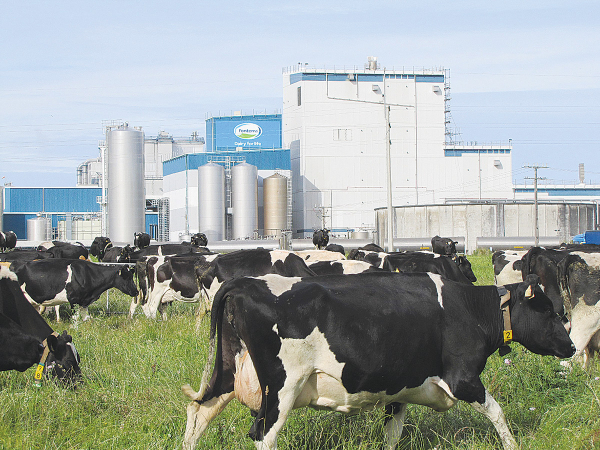 Rabobank says a well-balanced combination of carrot and stick will be needed to help dairy companies reduce greenhouse gas emissions.
With increasing and rising financial challenges, a well-balanced combination of carrot and stick will be needed to help dairy companies reduce greenhouse gas (GHG) emissions.
That's according to Rabobank's recent Global dairy companies taking the lead in reducing greenhouse gas emissions report. It points out that dairy companies are in a delicate position to balance the interests of their milk suppliers and other stakeholders, all while tracking other sustainability targets and maintaining healthy margins.
"Reducing emissions - especially scope 3 emissions that happen on the farm - has been on the agenda of leading dairy companies for many years," says the report. "Historically, productivity gains have led to more efficient milk production and lower emissions per kilogram of milk, but more comprehensive reduction strategies are needed."
Rabobank dairy analyst Richard Scheper says that for dairy companies to reach the 2030 climate goals and beyond, accelerating the adoption of on-farm GHG emissions reduction measures is critical.
"Reductions originating from productivity and efficiency gains may diminish over time and gains from new technologies may take years to achieve."
Rabobank Head of Sustainable Business Development Blake Holgate points to their 2023 The great New Zealand balancing act white paper for some of its key building blocks to achieve emissions efficiency and properly incentivise farmers.
"Joint efforts across public and private sectors, market access and trade agreements linked to sustainability and careful offsetting of emissions are essential to deliver strong stories on the change executed along the food supply chain and its benefits."
Holgate adds that Rabobank is currently developing a further white paper to be released later in 2024 to explore the topic further.
In 2010 the International Dairy Foundation created the first guide for a standard life-cycle assessment methodology and most countries in the global Top 20 have set climate targets or made a voluntary commitment with the Science Based Targets initiative (SBTi).
However, as target levels, timing, and scope can differ among companies depending on their regulatory environment, corporate structure or public pressure, this can create inconsistent expectations and subject dairy companies to reputational and litigation risks if targets aren't achieved.
For example, in many countries the main source of GHGs is fossil fuels from energy and industry, thus those countries contribution to reducing GHGs mostly focusing on energy and industry. This industry focus could include dairy processing emissions, but not on-farm emissions.
But in New Zealand the main source of GHG emissions is agriculture, thus there would be greater scrutiny and higher standards placed on New Zealand's agricultural emissions than most other EU countries.
The report warns that market access could be restricted or limited if competitors are meeting their targets and the market demands that other companies do so.
It also says reaching these targets will require a balanced combination of incentivising carrots and potentially corrective sticks to accelerate on-farm adoption of a wider variety of GHG emission reduction tools.
"It's of the utmost importance that all parties and stakeholders in the value chain contribute financially to these efforts - from the farm to the end consumer, plus (local) governments via stimulating subsidies (carrots) and/or taxes (sticks) and other stakeholders, such as banks."
Twenty-eight emerging leaders from across the horticulture sector spent two days last month learning valuable skills and connecting with industry experts.

A 'tsunami' of milk from key exporting countries is winding down and this may be good news for New Zealand dairy farmers.
Researchers at Massey University are using a special piece of scientific equipment to improve the measurement of greenhouse gas emissions from pasture soils.
Chinese beef trade quotas and a looming suspension of Brazilian beef imports into the European Union are expected to reshape global beef trade flows over the remainder of 2026, with implications for New Zealand exporters, according to Rabobank's Q3 Global Beef Quarterly report.
New Zealand consumers are paying more for beef mince than ever before, with the average retail price now sitting above $24 per kilogram, according to Rabobank.


Farmers are being encouraged to rethink how they manage waste on farm with the launch of ruralwastesorted.co.nz, a new website bringing together practical tips, real farmer experiences and resources.

New Zealand Winegrowers (NZW) is celebrating the India-New Zealand Free Trade Agreement (FTA) coming into force today, bringing New Zealand wine improved access to one of the world’s fastest-growing economies.
New Zealand’s red meat sector has welcomed the India-New Zealand Free Trade Agreement taking effect, which removes India’s 33% tariff on New Zealand sheepmeat.
More than 95 per cent of New Zealand’s forestry and wood exports to India can now enter tariff free as the New Zealand-India Free Trade Agreement comes into force today.
Federated Farmers is backing Feilding High School’s call to keep Agriculture and Horticultural Science as a standalone subject in Year 11.
Food and fibre exports have returned a billion- dollar bonus to the country.